A Gathering Storm
Perfect storm of shutdown threats, funding cuts, and layoffs at federal weather and science agencies threatens US weather-readiness

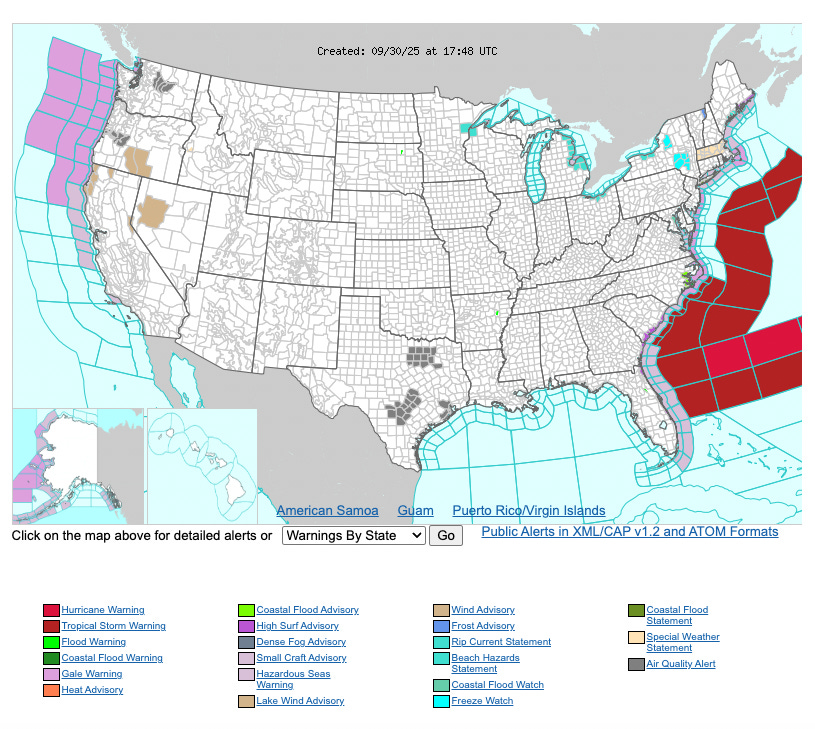
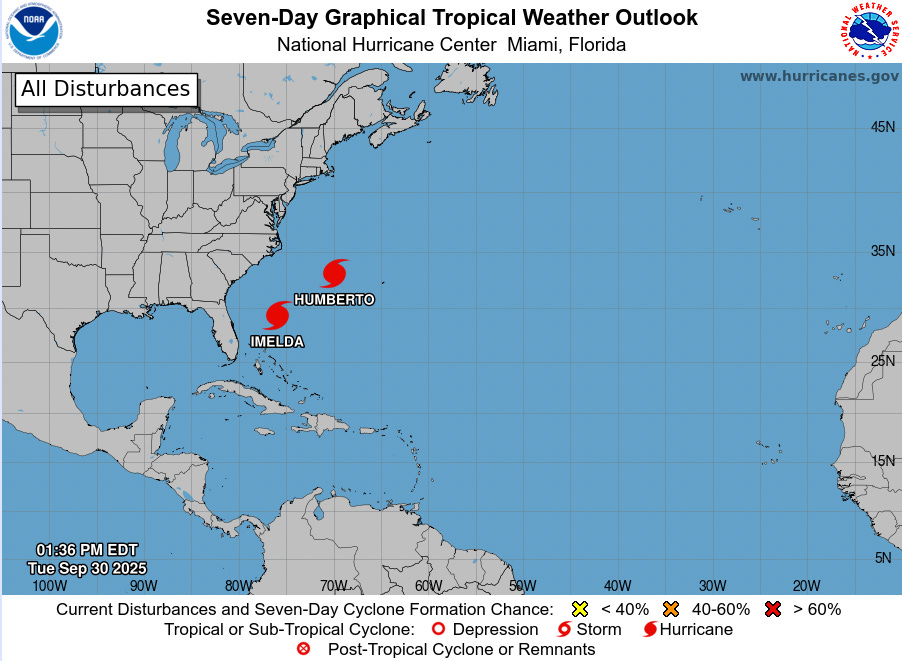
It’s a familiar scene in late September - two bright red hurricane symbols off the coast of the southeastern United States. Imelda and Humberto are the two hurricanes whose proximity to each other and to the southeastern US coastline have had coastal residents on guard this week.
Last week it appeared that Imelda might make a turn toward the west, potentially making landfall in North Carolina, a state which is still recovering from Hurricane Helene’s violent flooding last year. The language of the forecast was characteristically calm and steady, patiently explaining the factors at play and identifying which coastal areas needed to keep a lookout. Fortunately this week the last piece of the forecast puzzle emerged, the interaction between Hurricane Imelda and Hurricane Humberto would draw Imelda to the east, meaning it would move out to sea instead of hitting the Carolinas.
This change in the forecast brings with it a welcome sigh of relief for residents of North Carolina. But the situation is a reminder of just how much we depend on our federal hurricane infrastructure.
Forecast models help assimilate data from hundreds of different sources to give forecasters an idea of the possibilities. Meteorologists with decades of experience interpret model data and incorporate their own experience and knowledge to put model forecasts in context. Forecasters help explain the probabilities and forecast possibilities to the public, helping coastal residents wade through the risk assessment that accompanies each storm that approaches the coast. Satellite imagery and other data, maintained by federal agencies like NOAA allow forecasters and coastal residents to keep an eye on a storm, watching its movement, seeing when it looks more or less organized, and watching the way the storm’s circulation responds to synoptic-scale meteorological features.
If the storm were to make landfall and cause flooding or property loss, coastal residents know they can rely on a network of emergency responders to keep them safe in the short term and help them recover and return to normal in the long term.
It’s difficult to imagine a US hurricane landfall without the benefit of our federal agencies. The Atlantic Hurricane Season runs until the end of November. With more than eight weeks to go in a season forecast to be a significant one, US coastal residents are asking what will happen in the event of a government shutdown.
If coastal residents are concerned about how we could weather a hurricane landfall without the federal infrastructure we have come to depend on, that means Oklahoma residents should be worried about how we would weather a tornado outbreak without the Storm Prediction Center. Farmers and residents in the Mississippi River Valley should be worried about the National Water Prediction Service or the Advanced Hydrologic Prediction Center. And we should all be worried about how the US will adapt and prepare for climate change after the federal climate monitoring and adaptation infrastructure is dismantled.
If the US Senate is not able to reach agreement on a short-term continuing resolution to keep the government open, the government will shut down just after midnight tonight. What that means for the country’s weather and science enterprise is unclear. During the last shutdown in 2018, operational weather forecasters, who are employees of the National Oceanic and Oceanic Administration, part of the Department of Commerce, continued issuing forecasts and severe weather warnings. Those employees were considered essential, although other staff in National Weather Service offices not directly involved in forecasting were not and were furloughed. What happens in a 2025 shutdown is unclear.
Complicating matters is a memo released last week by the White House Budget Office directing federal agencies to prepare for permanent reductions in force in the event of a shutdown. Observers fear that would include additional cuts to personnel at the National Weather Service, Storm Prediction Center, National Hurricane Center, and other operational agencies that warn us about dangerous weather. Combined with earlier reductions in force, shutdown-related cuts could severely limit the effectiveness of the agency.
The potential shutdown is just the most recent in a series of changes in funding and staffing at the federal agencies that monitor and predict weather, issue warnings, and respond to natural disasters which began earlier this year.
In July the Department of Defense floated the idea of shutting down operations of several satellites critical to hurricane monitoring and forecasting. At the last minute and after significant pushback DOD reversed the decision and the satellites remained operational. Earlier this summer NOAA released a budget which proposed closing the Atlantic Oceanographic and Meteorological Laboratory and its Hurricane Research Division, a world class tropical cyclone research center which also supports operational hurricane forecasters by maintaining hurricane forecast models. NOAA Hurricane Hunter aircraft flights into potentially dangerous tropical cyclones, an indispensable tool in hurricane forecasting, also faced budget cuts this year.
Funding cuts, staffing changes, and other unnecessary disruption to our weather and climate infrastructure mean at best distracted and under-resourced forecasters. It is simply luck that has kept the US from facing a major hurricane landfall in this weakened state. But hurricane season is not over and it only takes one significant landfall to make a noteworthy season.
Changes in procedure and key staffing roles at the Federal Emergency Management Agency have already proved to slow agency response during the devastating Texas flash floods in July. Layoffs and other changes have continued in the months since the Texas floods. Emergency management experts largely agree that the agency could be streamlined to improve effectiveness, but changes at the agency so far do not appear to be in line with expert recommendations.
Experts are sounding the alarm that the US scientific agencies are at risk.
This is one shutdown fight that has immediate consequences for Texas. Disrupting the country’s weather forecasting infrastructure will have immediate effects on the state. Closing labs responsible for better understanding severe weather, hurricanes, and droughts will have longer term effects.
And, since many of these changes are part of an effort to eliminate any scientific research from the federal government that is relevant to climate change, it is worth pointing out that Texas is vulnerable to every single climate impact except for glacial lake outburst floods. We cannot change our risk of weather and climate-related disasters by turning off the satellites and exiling the scientists.