

Find Your Fire
fired up and ready to go after the Religious Freedom in Public Schools Summit

“If you leave here without being on fire,” Rev. Charles Johnson’s southern drawl rang out in the large hotel conference room, engaging with a rapt audience of organizers from across the country, “your wood’s all wet.”
By the end of the Religious Freedom in Public Schools Summit, there wasn’t a damp log in the room.
The two-day event was hosted in Dallas by Interfaith Alliance and other organizations dedicated to the fight for religious freedom, including Texas Impact. It featured guests and speakers from across the country, addressing threats to religious freedom in public schools on the local, state, and federal level. The topics varied: school vouchers, posting the 10 Commandments in classrooms, and religious discrimination, to name only a few.
“When we uplift public education, we uplift religious freedom,” Maggie Siddiqi, a Senior Fellow at Interfaith Alliance, said. “And when we uplift religious freedom, we uplift public education.”
School Vouchers
Randi Weingarten, president of the American Federation of Teachers, did not mince words about school vouchers.
They “defund public schools,” she said, “and direct money mostly to people who already send their kids to private schools.”
Weingarten, a co-keynote speaker along with her wife Rabbi Sharon Kleinbaum, also explained that dismantling the separation of church and state in public schools is not only a blow to the First Amendment; it is also “untenable” and burdensome for teachers and students alike.
Rev. Johnson, the founder and co-pastor of Bread Fellowship in Fort Worth, also criticized school vouchers as “a subsidy for religious schools.”
We can think of our work in terms of an “inverted pyramid,” Rev. Johnson explained, starting with grassroots organizing to build local support before taking the fight to lawmakers.
Commandments, Curriculum, and Chaplains
It is irresponsible to, as Dr. Steven Green of Willamette University put it, take politicians from 249 years ago at their word.
“We need to understand context,” he said. “You can’t take history at face value,” to determine a modern interpretation of the law.
He compared two different quotes from George Washington—one in which our first president asserted that, “Morality is a necessary spring of popular government. Reason and experience both forbid us to expect that national morality can prevail in the exclusion of religious principle.”
Dr. Green contrasted that message with part of a letter from Washington to a Hebrew Congregation in 1790: “It is now no more that toleration is spoken of…the United States…gives bigotry no sanction.”
While Dr. Green encouraged us not to be “handcuffed by the past,” other speakers talked about the present religious presence in public schools. One example: Bluebonnet Learning, a controversial elementary school curriculum that critics say is rife with religious bias and factual errors.
The State Board of Education approved the program, and many school districts across the state are adopting it. However, some religious freedom advocates say the strategies brought about some success and provided a blueprint for future battles.
Amanda Tyler, the executive director of the Baptist Joint Committee for Religious Liberty, explained that grassroots organizing led to them being able to display vigorous opposition to the program, particularly during the public comment phase. She credits those efforts for leading to positive changes to the curriculum and bipartisan votes against its passage.
This was “a win for organizing,” she said, and it shows that we have to “reduce barriers to entry for people to engage.”
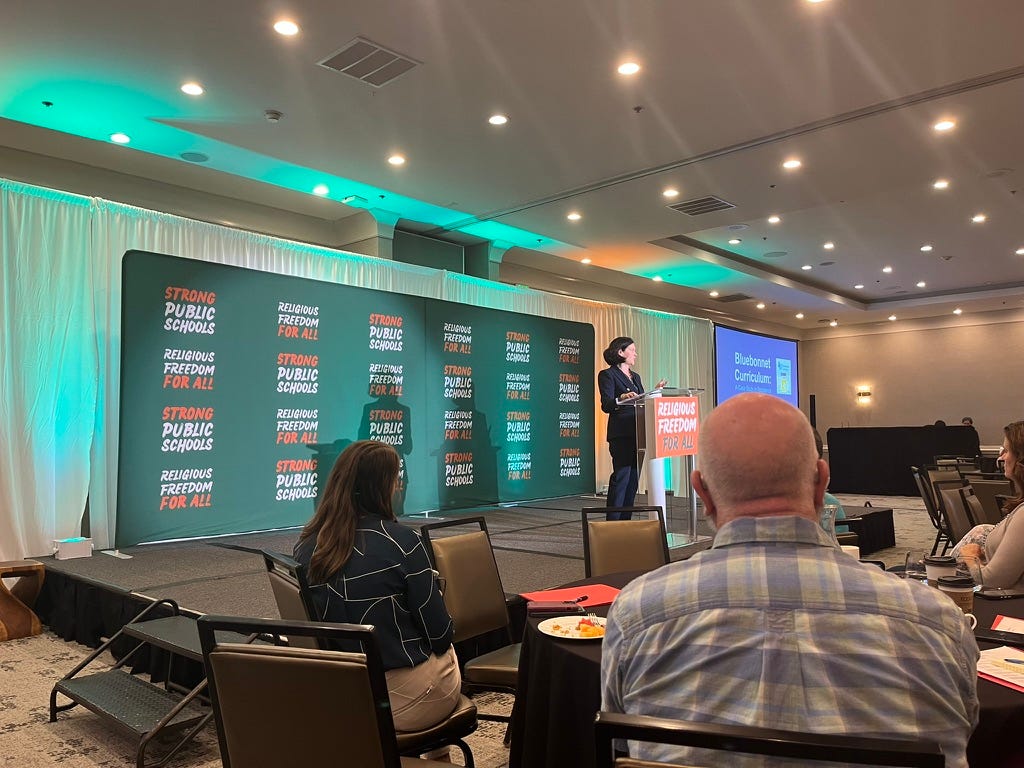
Curriculum is far from the only source of religious influence in the classroom. One panel of religious leaders explained why chaplains have a place in hospitals, prisons, the military, and even universities—but not public schools.
Ben Iten, a Pastoral Educator and Chaplain, said it “makes sense” for some secular spaces to have chaplains when people are away from their homes and support systems. Children in public schools, by contrast, are still living at home.
Religious Discrimination
Of course, those most profoundly impacted by the influence of religion—particularly Christianity—in public schools are students of minority faiths. As Savleen Singh of the Sikh Coalition made clear, we have to be vigilant about recognizing and mitigating harm to vulnerable students.
“[We need to] move defense to offense,” she said, and make sure “every child is seen and respected and has the ability to thrive.”
The way to do that, Singh said, involves focusing on curriculum, teacher training, and policy.
Dahlia Taha, from Muslim Public Affairs Council, had similar advice, telling advocates to “document violations. Don’t let them be trivialized."
She also highlighted the need to train teachers to handle conflict and provide accommodations, such as time off for holidays and food that meets their dietary restrictions.
What’s Next?
While the strategies for each fight discussed at the conference might differ, if there was one common call to action, it was the need to stay connected, active, and—perhaps most importantly—faithful.
One of the panels featured Executive Director of Texas Impact Bee Moorhead, Rabbi Mara Nathan, and Felicia Martin, the president and executive director of Texas Freedom Network. Moorhead emphasized the need to stop Christian nationalism from changing what it means to be a religious person in the United States.
We can resist, Moorhead said, in part by simply “being people of faith who are not Christian nationalists and making sure people know they’re not alone.”
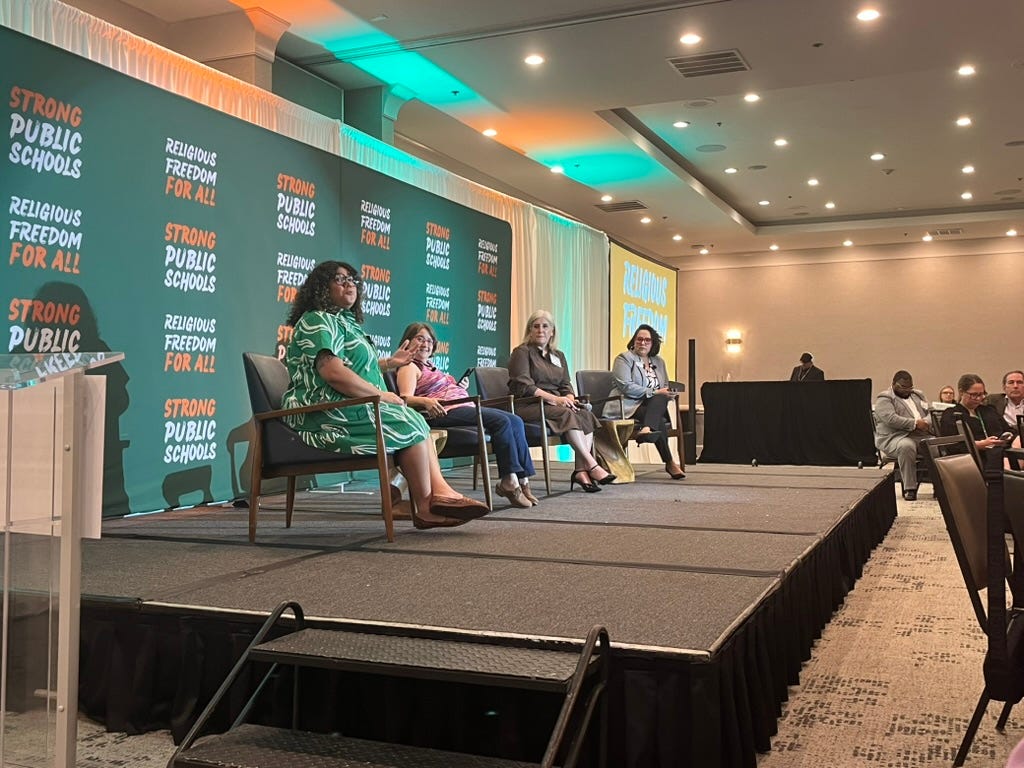
Skye Perryman is the president and CEO of Democracy Forward, and she was named one of Time 100’s 2025 100 Most Influential People In The World. Her message was clear: the effort to save our society from backsliding further into autocracy is “a local fight with profound global consequences.”
It’s easy to leave a room full of advocates, experts, and like-minded people feeling inspired and ready to get to work. The hard part is staying motivated when the hotel conference room is long behind us. Even when it feels like we’re alone. Even when the chasm between where we are, and where we want to be, seems to be growing every second.
Inspiration can be found in community, but it can also come from within. Keep your wood dry; you never know when you’ll get a spark.