

Focus, focus, focus.


As each day brings fresh disturbing news and we see many of our commonly held paradigms shaken, it can be easy to become absorbed in the dramatic events we see each day. It’s kind of like passing a bad wreck on the highway—you can’t not look, it’s just too compelling. But there is usually nothing for passers-by to do except stay out of the way of medical experts and public safety personnel. So we drive on—maybe offering a prayer of gratitude for all the advocacy that created those emergency systems in the first place.
Public policies are what implement the systems that administer prompt expert medical care, clear the roadways, require safety standards in automobiles, and direct traffic after collisions. Public policy decisions don’t just happen; someone makes them happen. And voters choose those “someones” through the electoral process. Those who think that voting doesn’t matter are either kidding themselves or are in deep denial of their responsibility as a member of a democratic republic.
For those of us raised on the story of the Good Samaritan, we would do well to update our thinking. Adopting compassionate public policies and eschewing harmful public policies is how we recognize everyone as our neighbor and spend the needed resources to care for them, even for those to whom we don’t feel particularly neighborly. We must learn to view the heart-breaking tragedies in the state and the world as a prompt to play our appropriate role—what is right in front of us. What is that role? To pay attention, to engage our communities in civic live, and most immediately, to prepare for the runoff elections in May and the midterm elections in November.
As we get closer to the midterm elections there will be an increase in the pressure put on local election administrators and our election processes. This is true particularly in Texas where the likelihood of a change in the current balance of power may be growing. Therefore, it is incumbent on us to step up our vigilance and participation. Deeper participation in the electoral process, even beyond simply casting our own vote, becomes our responsibility as we see warning signs that the electoral process is struggling.
Here are three examples of situations that happened in the March primaries that we election advocates should be aware of.
Dallas and Williamson County Precinct-Only Voting Confusion
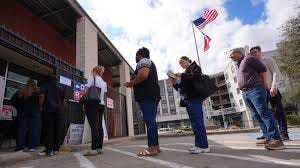
The Republican Party chairs of Dallas and Williamson counties withdrew from the voluntary countywide voting program and mandated that voters use specific, assigned precinct locations on Election Day. This forced a “non-joint” primary, separating Republican voting locations from Democratic ones and resulting in widespread voter confusion and hours-long waits to vote on election day. Even though a nonprofit organization kindly sent pizza to those waiting in long lines, frustration ran high and lives were disrupted by the confusion.
Lawsuits were filed to extend voting hours allowing voters time to find their correct location. This was granted by a district court in Dallas and a county judge in Williamson county. However, Attorney General Paxton later challenged the orders, and the Texas Supreme Court blocked the order of the lower courts. This required that the ballots cast by voters who were not in line by 7pm be separated and held back. Those ballots may or may not be counted, depending on how the lawsuits on extending the hours ultimately play out.
A Move to Hand-counting Ballots
In a few smaller counties, Republican Party officials decided to hand-count ballots rather than using voting machines. In Calhoun, Gillespie, and Eastland counties, Republicans hand-counted ballots cast in the primary election. In so doing, Calhoun County was not able to report its results until Friday after the election, missing the state-mandated deadline. (State law requires election results be submitted within 24 hours of polls closing.) There were numerous other delays and mishaps in this process. For example, Votebeat Texas reports that in Eastland, election officials did not report totals to the state until about 5:45 p.m. Wednesday, and said they had to obtain a court order to access a secured box containing ballots after a form containing tallies from one precinct was mistakenly locked inside. Dallas County considered moving to hand-counting ballots, but abandoned the plan due to high costs and the lack of volunteers.
New Law Effecting Elections, Passed in the Last Legislative Session
In the last legislative session, SB 509 filed by Sen. Bettencourt was signed into law. This requires all courts in Texas to notify the Office of the Attorney General (OAG) of any hearing on an application for a temporary restraining order (TRO) under the Election Code. A TRO is a very common legal procedure used by judges and election administrators to keep elections running when issues arise. This notice must give the OAG one hour’s notice to allow them to participate remotely in any hearing on a temporary restraining order brought under the Election Code.
For example, El Paso county experienced technical issues with the voting machines at some of their polling locations. The issue was diagnosed at 11am and resolved by 1pm. Since it caused some confusion and impacted voters’ ability to cast their vote during a busy time, the election administrator’s office filed a TRO requesting the court extend voting hours to make up for machine delays. In this case, it was a 4-minute, uncontested court hearing that allowed El Paso voters not to lose access to voting due to technical difficulties. The new law required the judge to delay their ruling by one hour in case the OAG wanted to intervene on the issue. (In this case, the OAG did not intervene.) The unopposed order was signed, El Paso voters got extra time, and those ballots were counted.
In any endeavor as massive and complex as statewide elections, there are bound to be differing opinions about how best to administer the process. This is especially true given the high-stakes nature of elections when there are fierce competing interests. Public policy matters—whether it is passing a law to allow the OAG to weigh in on county election matters or requiring counties to submit election results within 24 hours of the election—the effects of policy trickle down to real-life events affecting real people’s lives. That is why it is even more important than ever that nonpartisan, faith-based advocates step up and be a part of the process.
How To Step Up NOW for November Midterms
Midterm elections are a mere 8 months away. The time to “stir the waters” within our congregations is now. We must understand what is at stake and help our brothers and sisters, friends and neighbors become aware as well. Here are some ways now to get ready for November:
Educate YOURSELF. We can help! Contact Texas Faith Votes and participate in Zoom calls where we discuss the latest in election practices and happenings around the state. Join our ever growing cadre of (affectionately dubbed) “election nerds.”
Talk to people about elections. INITIATE conversations with your network of relationships. Hold a Virtual House Party with a bunch of friends to plan your participation in your community’s election process.
VOLUNTEER to be a poll monitor in November. Texas Impact can connect you to ways to be the vital eyes and ears of what’s happening at the polls.
Tell your STORY. If you saw something noteworthy at the polls or know someone who experienced long lines or confusion at the polls, please let us know at staff@texasimpact.org.
Create a BUZZ within your congregation.
Meet with your social concerns committee.
Share this post.
Post election dates in your bulletin or on social media.
Subscribe to Votebeat Texas.
It’s important to make elections and voting a regular part of the culture of your congregation. Together, we can be a wholesome and healing presence in a process that is vital to the well-being of our community.