

Fostering Moral Deliberation
Part Three in a series on religious social statements

From Living Lutheran, the magazine of the ELCA
For this week’s installment in my series on religious social statements, I’m turning my attention from the Presbyterian framework for faithful citizenship to the “Policies and Procedures of the Evangelical Lutheran Church in America for Addressing Social Concerns.” The Evangelical Lutheran Church in America (ELCA), like the Presbyterian Church (USA), was formed in the 1980s from the merger of predecessor bodies. Unlike the formation of PCUSA, however, the formation of the ELCA did not reunite previously united bodies. Instead, as this article describes, Lutherans immigrated to the US from several countries, leading to several American Lutheran associations that were initially closely identified with ethnic groups. The ELCA represents the consolidation of some of these associations.
The ELCA was founded in 1987, and its first social statement was, like the PCUSA statement “Reformed Faith and Politics,” an overview of the role of the church in society. The ELCA’s statement, called The Church in Society: A Lutheran Perspective, lays out the case for why the ELCA as a body should engage in social teaching and issue social statements and messages. Policies and Procedures for Addressing Social Concerns articulates in great detail the processes the ELCA has evolved to govern the development of social statements and messages.
At first blush, it might not seem likely that a document entitled “Policies and Procedures” would be interesting even for people who have to use the policies and procedures in their work—let for alone anyone else. But in fact, the ELCA’s policies and procedures are a reasonably good starting point to understand how a lot of faith communities figure out what to say about contemporary issues; how to say it; and even if they should say anything in the first place.
Statements, Messages, and Resolutions
The ELCA defines three types of social witness documents: social statements, social messages, and social policy resolutions.
Both social statements and social messages serve as teaching documents, although statements are primary, and messages may have a more deliberative character. ELCA social policy resolutions set focused and explicit directives and so serve as the main form of policy expression, although teaching documents often carry policy implications.
According to Policies and Procedures, these three kinds of social witness “become the context for bringing Lutheran theology into conversation with broad social institutions and concerns or specific topics seeking corporate conclusions. These conclusions always are open to further testing in the Spirit, but they set forth this church’s theological and ethical understanding and establish policy regarding individual and corporate Christian responsibility in the world. Together, they articulate church teaching, govern institutional action, provide for communal and personal discernment, and project moral vision.”
Policies and Procedures then outlines six distinctive characteristics of social teaching:
Social teaching is theological.
Social statements and messages are teaching documents.
Social teaching involves this church in the ongoing task of theological ethics.
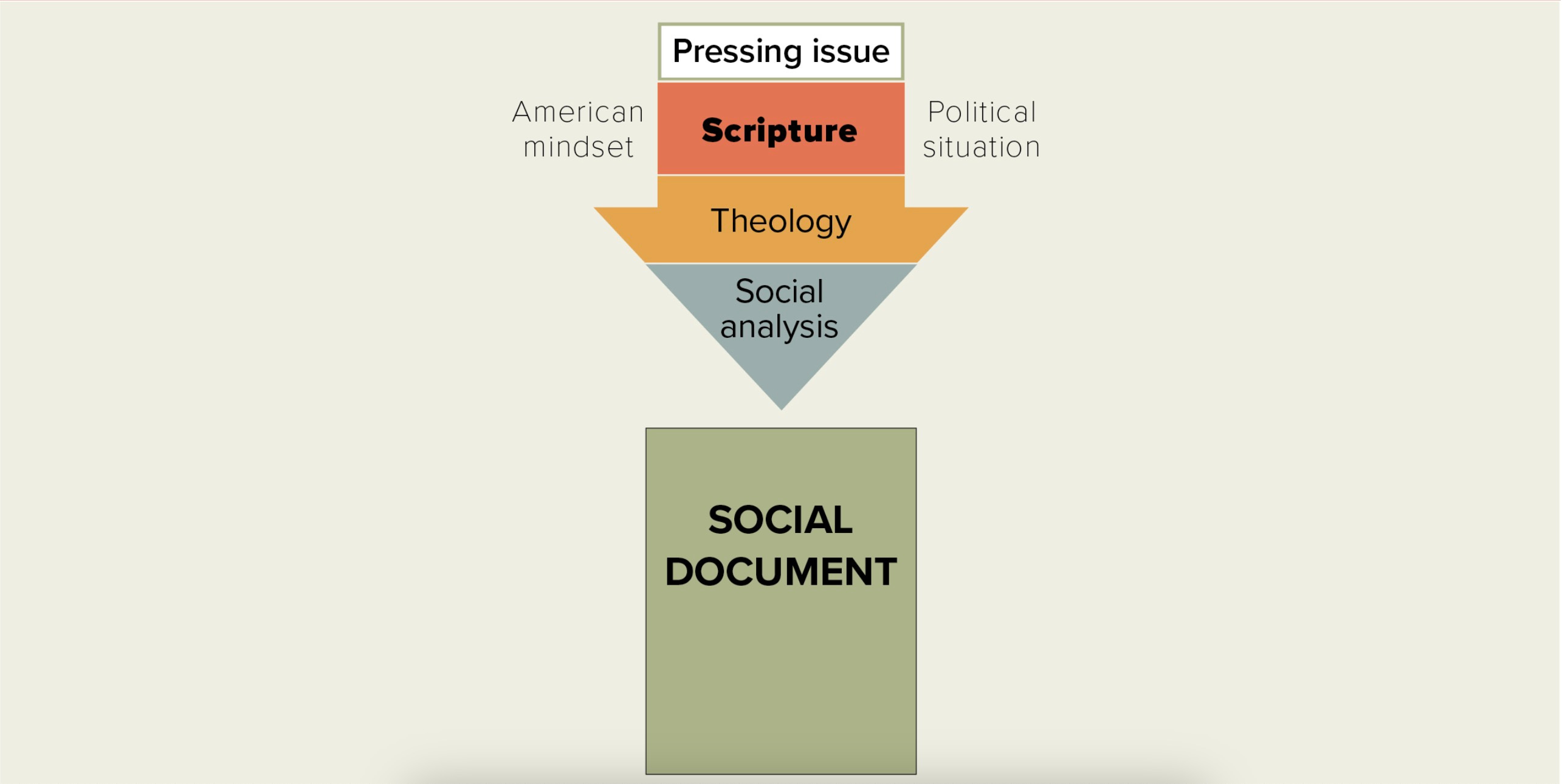
Social teaching and policy result from extensive, inclusive, and accepted processes of deliberation throughout this church.
Social teaching and policy documents govern the institutional life of this church.
Social teaching documents are intended to be used widely in the life and mission of this church and to reflect awareness of the various audiences and ministries that they are to serve.
“Extensive, Inclusive, and Accepted”
“Extensive, inclusive, and accepted processes of deliberation” describes the way most or all of Texas Impact’s member faith traditions develop social teaching and policy. Denominational social teaching typically is developed in a stepwise process where successive configurations of members engage in collective discernment. Often, social teachings are iterative, with one social statement building on—or, more rarely, revoking—an earlier statement.
“Reflecting awareness of the various audiences and ministries that they are to serve” also describes the norm for Texas Impact’s member faith traditions. Social teaching is designed to be used in a wide variety of settings, guiding individual and group behavior. Denominational subgroups or affiliates, including related bodies like pension funds, are expected to be responsive to social teachings—in fact, denominations are especially likely to draw the attention of the secular community when they adopt statements or policies that suggest or require countercultural actions on the part of their affiliated bodies.
Texas Impact’s policy positions and legislative agenda represent the intersection of the social teachings of our member faith traditions. When we take a position or recommend a course of action, we incorporate by extension the interpretive and discernment work academic theologians, lay leaders, activists, clergy, and others across many faith communities have already done. Sometimes, all that discernment seems overwrought, with small committees of invested individuals arguing passionately about perceived injustices that are of little interest to most members of their faith community. But other times, the process of denominational discernment spans years or decades, involving many or most members and leading to generational change.
Later this summer, the Texas Impact Leadership Council will adopt a legislative agenda for 2027-2028. In preparation, Leadership Council members are reflecting on their faith traditions’ social teachings on issues that will—or should—be under consideration in the legislative session. Understanding denominational discernment processes helps us understand how and why denominations come to the policy conclusions they do—and how their thinking can guide ours.
Love,

All the ELCA Social Statements have been a guide for my faith practices. They have been a great help in using them in discussions on the many different social issues.