


Schools across the state went back for the new school year this week and like many public school parents in Texas I associate the fall semester with football games. High schools across the state start training everything from cheerleading to band to football as early as mid-July so they can maximize every minute of their UIL-allotted practice time before the season begins.

And while many associate football weather with stadium blankets and steaming bowls of Frito pie, the beginning of the season in Texas is always HOT.
Heat stress is a real concern for high school athletes training outdoors at the end of the summer. School sports organizations have added automated external defibrillators to sideline first aid equipment, prohibited dangerous kinds of tackles, and improved helmet design to minimize brain injuries. Now, the University Interscholastic League (UIL) is taking on heat safety.
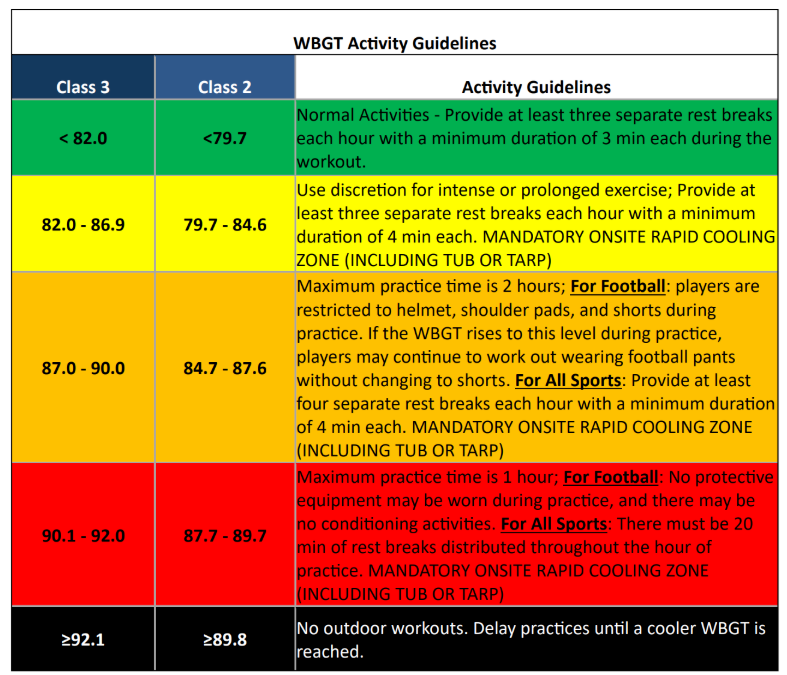
This year school athletic programs will be required to follow the “Heat Stress and Athletic Participation REQUIRED Plan”, in response to more frequent hotter temperatures, which can create dangerous conditions for both student athletes and adult staff.
The guidelines are based on the wet bulb globe temperature (WBGT), a measure of heat stress in direct sunlight which takes into account temperature, humidity, wind speed, sun angle, and cloud cover. The WBGT is a better measure of heat stress on the body than the heat index, which only considers temperature and humidity and is measured in the shade.
UIL guidelines require athletic programs to have rapid cooling equipment readily available, requires athletes have unlimited access to cold water during practices and games, suggests lengthening half time duration to allow athletes adequate time to rest and cool off, suggests moving practice and game times to avoid the hottest parts of the day, and provides specific guidance based on the wet bulb global temperature, which should be measured within fifteen minutes of the start of practice.
The World Health Organization reports that 489,000 heat-related deaths occur each year globally. Heat is the deadliest weather hazard, killing more people each year than things like lightning, hurricanes, flash flooding, and tornadoes. It impacts every system of the body, not just things like the kidneys and the cardiovascular system, but also the nervous system and mental health. Emergency physicians report more visits for violence, depression, and suicidality during heat waves.
For high school athletes, including cheerleaders and students in marching band, the danger of heat illness is real. The long outdoor workouts that have traditionally marked the end of the summer fall during the hottest part of the year. Add pads, helmets, and other equipment and the risk of heat stress is even higher.
Questions about the new heat stress regulations fall into two categories:
Does this mean we have lower expectations of today’s high school student athletes versus a generation ago?
Has the weather really gotten hotter?
It is easy to answer the last question. The weather in Texas has gotten hotter. According to Texas State Climatologist Dr. John Nielsen-Gammon, over the past fifty years most regions of the state have seen a tripling of the number of 100-degree days. Climate scientists project we will have four times as many 100-degree days in Texas by 2036, relative to the 1970s and 1980s.
Graphs for observed temperatures for the past five decades in three Texas cities are provided below. You can generate a plot for your location on the Southern Climate Impacts Planning Program Temperature Trends Dashboard.
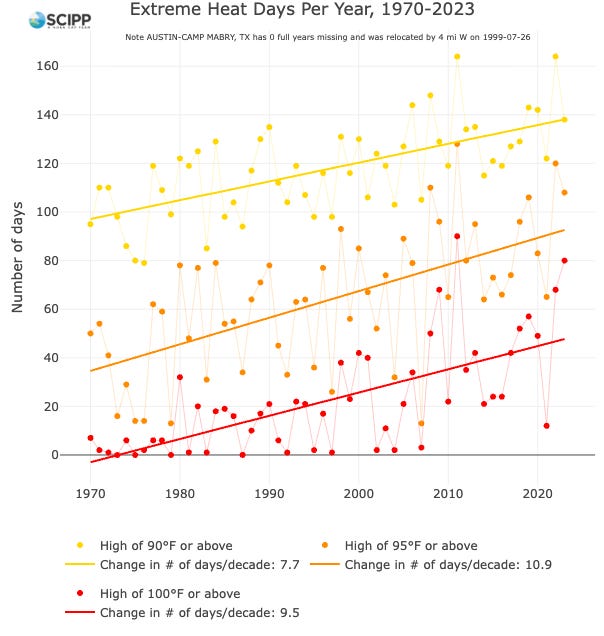
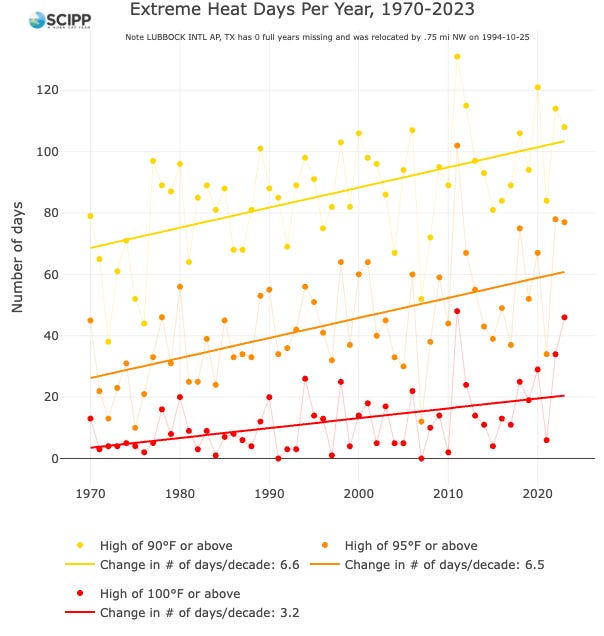
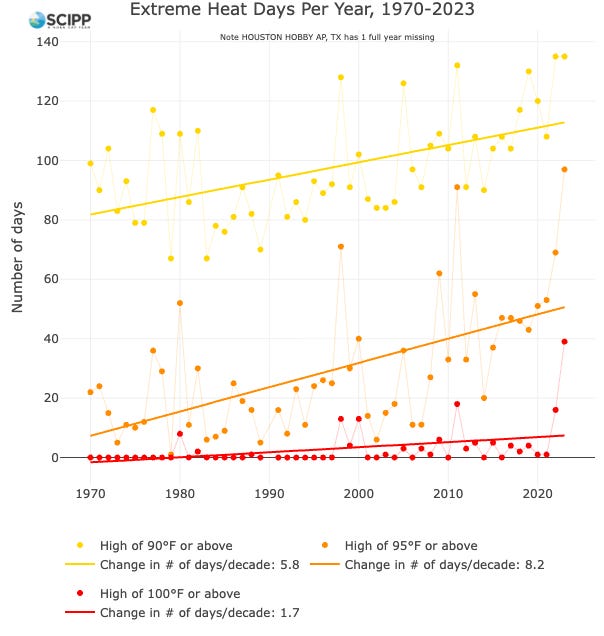
The United States just experienced its hottest month in recorded history. July’s average for the continental United States (76.89°F) was 0.12°F above the previous record from July 1936, during the Dust Bowl. Recorded temperature data in the United States goes back to 1895.
Trends in temperature data support more caution around heat, especially in Texas. Whether you think teenagers are more or less resilient than a generation ago is more subjective. But the new requirements are not about avoiding discomfort in the heat; they are about avoiding heat stroke, a life-threatening emergency.
Parents, coaches, and athletes worry that less practice time will affect competitiveness. For statewide championships, schools in locations with higher temperatures could end up with less practice time than schools in cooler parts of the state. And since the requirements apply only to practices, how can coaches ensure athletes are acclimatized to the heat for game day?
Some coaches argue that individual schools and districts have already made changes in practice times and other procedures to ensure athlete safety, even without the new requirements. Some schools hold football practice late at night or early in the morning, for example. Or add more water and shade breaks.
Some school districts have built indoor practice facilities so they can continue working even on the hottest days (Prosper ISD, Melissa ISD, Lago Vista ISD, Round Rock High School near Austin installed turf in a gym to facilitate indoor football practice).
It’s not just the large 6A school districts investing in indoor athletic infrastructure. 2A Plains ISD, in Plains (population 1,355) in far west Texas, began construction on a $21 million indoor practice facility earlier this year.
Officials from Plains cite revenue from oil and gas operations in the region as one way they are paying for the new facility. That leaves open the question of fairness for student athletes in less resourced communities.
The stakes of high school athletics are high. Not only do high school football games draw huge crowds, for some communities they mark the rhythm of the week like a civic religion. Student athletes learn discipline, work ethic, and teamwork from participation in sports. Many students depend on sports as a route to college.
The Texas high school sports infrastructure arms race (the college where I once taught used the town’s very large high school stadium for its football games) makes for an easy joke, but it’s also true that playing sports is healthy and fun. Investing in modern facilities for public school students and community members is a worthy use of funds. And heat safety is important.
School districts, cities, and county governments must adapt to the changing climate and include heat safety when planning outdoor activities during the warmer months.