

From Shutdown to Show Up
In a season of manufactured crisis, choose Beloved Community

Guest post by Min. Christian S. Watkins, Government Relations Advocate, NETWORK Lobby
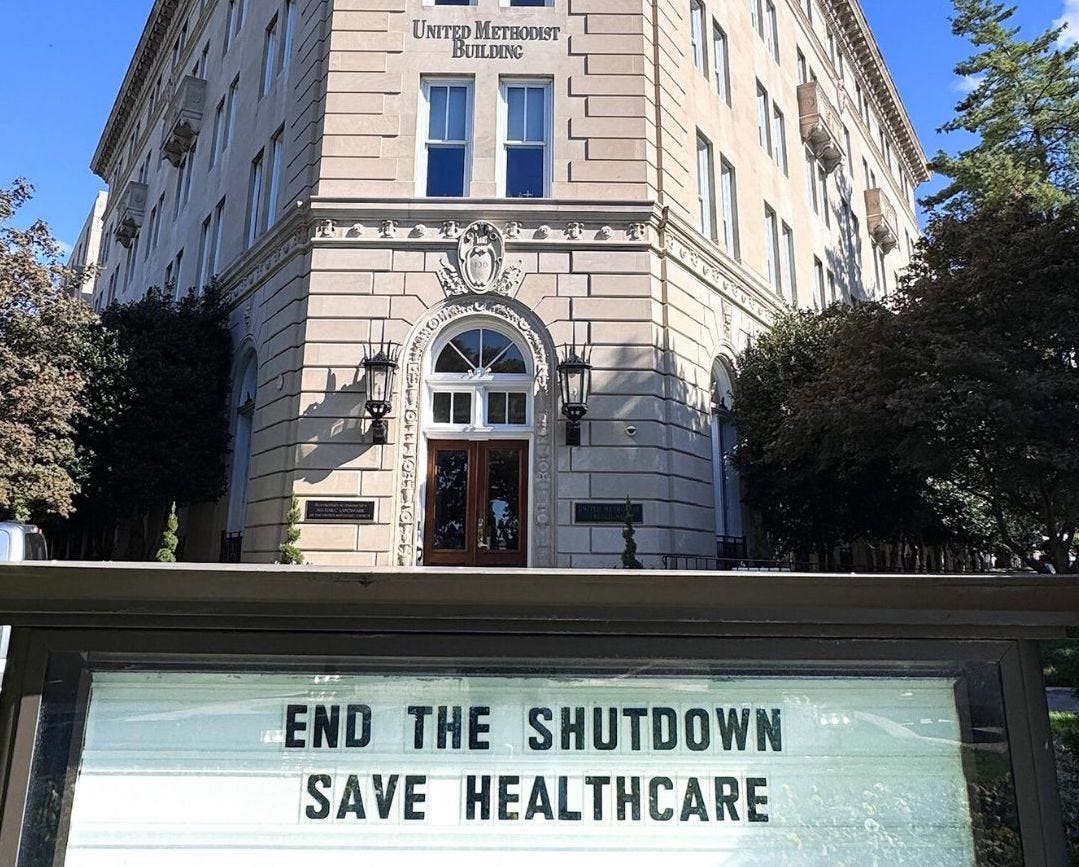
The United Methodist Building on Capitol Hill
This is a moment to rewrite the story of what our United States should be. How we pray, organize, advocate, and show up in this moment will shape whether this moment accelerates our slide toward authoritarianism and division, or becomes a pivot toward a multiracial, multifaith Beloved Community grounded in dignity and the common good.
The United States is suffering with a partially shuttered government and a public square fraying under the strain of polarization. This isn’t a routine budget spat; it’s a stress test of our democratic muscle and moral imagination. Even as agencies darken their doors and families brace for missed paychecks, the Administration shields favored priorities—especially immigration enforcement and trade—so they keep humming while the common good stalls.
Since January, it has been a slow-motion shutdown: the new Department of Government Efficiency (DOGE), a 1-for-4 backfill cap (with immigration and law enforcement exempted), accelerated RIF planning, and permission to reorganize or eliminate offices not explicitly mandated by statute. That’s not belt-tightening; it’s a priorities-first, partial government—militarized enforcement protected, social capacity sacrificed.
DOGE’s playbook—hiring freezes, probationary firings, “deferred resignations”—pushed more than 200,000 public servants out by late September. At the same time, rescissions yanked billions already approved (H.R. 4 and a later “pocket rescission”), starving programs mid-stream and leaving partners worldwide in limbo. The pattern is consistent: keep parks “open” on user fees despite prior legal warnings; keep trade and immigration enforcement funded or excepted while civilian functions furlough; and order RIF plans during the shutdown itself to convert a temporary lapse into permanent shrinkage. The impacts are concrete: up to 750,000 workers furloughed or working unpaid; DHS largely on duty without pay while critical civilian cyber capacity braces for furloughs; SNAP-Ed zeroed out; CPB cutbacks weakening local emergency communications; foreign-aid freezes stalling health and humanitarian efforts. Meanwhile, the supposed “savings” of broad cuts often cost more than they save—and agencies have been told to treat layoff implementation as “excepted work,” locking in lasting harm.
What we have witnessed and are experiencing is a manufactured crisis layered onto a year of purposeful dismantling—prioritizing immigrant detention, hyper militarization, and tariff collections while sidelining care, science, and service. This is not neutral technocracy; these are political choices with human consequences.
But, We the People must not despair. As Bishop Dwayne Royster reminds us, this is a moment to rewrite the story of what our United States should be. How we pray, organize, advocate, and show up in this moment will shape whether this moment accelerates our slide toward authoritarianism and division, or becomes a pivot toward a multiracial, multifaith Beloved Community grounded in dignity and the common good.
What Our Faiths Offer in This Moment
Black liberation theology begins where the prophets and Jesus locate God—with the oppressed. James Cone’s authorship reminds us that God’s liberating love confronts unjust systems, not just individual sin. Womanist theologians like Delores S. Williams press us further: liberation that ignores Black women’s experience isn’t liberation at all. Any “return to normal” that leaves exploited communities to bear the costs of political theater is a counterfeit peace.
Rev. Dr. Martin Luther King, Jr. called us beyond the politics of domination toward the Beloved Community, where justice is love made public. That vision is not passive. It requires nonviolent resistance, a disciplined refusal to cooperate with evil, and a commitment to transform opponents rather than destroy them. “Non-cooperation with evil is as much a moral obligation as is cooperation with good.”[2]
The research backs the movement wisdom: across the last century, nonviolent campaigns have been twice as successful as violent ones[3], in part because they invite broad, diverse participation and trigger defections from oppressive systems. We don’t need a majority to act; we need a courageous faithful remnant willing to persist together.
Across traditions, our faiths insist on the dignity of the human person, the common good, rights and responsibilities, solidarity; and subsidiarity—ordering power closest to the people it affects. These principles aren’t abstractions, they are the foundations of our faith and the criteria in which to judge policies and budgets. When a government tactic jeopardizes the basic security of workers and families to “win” an unbalanced negotiation, it violates the moral order these principles describe.
Pope Francis named our challenge with clarity: an “economy of exclusion” that treats people as disposable. Pope Leo XIV doubles down, “We cannot love God, whom we cannot see, while despising his creatures. Nor can we call ourselves disciples of Jesus Christ without participating in his outlook on creation and his care for all that is fragile and wounded.”[1]
The Gospel leaves no room for selective compassion—toward migrants, the poor, democracy itself, or the Earth we share. In this season, we choose moral clarity and conviction: to reject scapegoating and cruelty in our politics; to protect the vote and a nonpartisan civil service; to side publicly with workers, immigrants, and families harmed by manufactured crises; and to practice Gospel nonviolence that confronts lies with truth and fear with organized love.
What This Moment Demands
American faith communities have long insisted that democracy is sacred work: protect the vote, count every vote, and secure a multiracial, multifaith democracy where every person can participate and thrive. We have opposed attempts to strip voting rights, denounced white Christian nationalism as a heresy against both faith and the Constitution, and condemned the federalization and militarization of Washington, DC as an assault on human dignity and neighbor love. Today’s shutdown tactic—paired with plans to shield favored priorities while threatening mass firings—fits the same pattern. We must resist it.
Every one of our widely shared priorities—health care, housing, immigration, tax and climate justice, equitable pay—depends on a functioning, inclusive democracy. When democratic norms get gamed, people at the margins pay first: millions were dropped from Medicaid during “unwinding,”[4] often for paperwork glitches rather than true ineligibility, and budget brinkmanship puts that coverage at risk again; meanwhile, the nation faces a shortage of 7.1 million affordable homes for extremely low-income renters and eviction filings remain elevated across tracked cities; immigration courts carry a backlog topping 3.4 million cases, even as the government had to extend work-permit renewals up to 540 days just to keep families and employers afloat; and a captured policymaking process protects loopholes while workers still see a union wage premium and women earn about 81% of men’s weekly pay. In short: when participation and fair administration erode, care, shelter, status, and wages erode with them.
From Analysis to Action: Shifting the Paradigm
Practice Gospel nonviolence—publicly and persistently.
Nonviolence is more than the absence of harm; it is the presence of courageous, organized love. Plan and join nonviolent actions that highlight the human costs of the shutdown—lines of solidarity outside shuttered agencies, prayer vigils at district offices, creative “people’s hearings” that center low-income families, immigrants, and federal workers. Keep your messaging invitational: talk to your neighbors who disagree. The goal is not humiliation; it is transformation.
Conscientious noncompliance with unjust directives.
If officials use the shutdown to force retaliatory furloughs, evictions from services, or targeted crackdowns, conscientious noncompliance may be required. King’s ethic guides us: we accept legal consequences without surrendering moral agency, while working for just laws. Unjust orders that violate rights and human dignity should not be normalized by quiet compliance. Document abuses, retain counsel, act in coalitions, and keep your tactics nonviolent and transparent. SMU
Build mutual aid that outlasts the crisis.
When paychecks stop, the Church and civil society step in. Parishes and community groups can stand up rapid-response funds, grocery gift-card drives, and rent-bridge ministries for furloughed workers and contractors (who often do not receive back pay). Map needs, assign neighborhood captains, and publish simple intake forms in multiple languages. That is solidarity—love organized. ABC News
Fight nonviolently for a democratic reset.
Channel righteous energy into policy:
Restore and expand voting rights and reject executive or legislative schemes that suppress the vote.
Advance DC statehood and end punitive federal interventions in local governance.
Protect the civil service from ideological purges; modernize hiring and retention for the common good, not partisan gain.
Fund the safety net and community services first in any budget, with an explicit racial-equity lens.
These are not partisan stances; they are moral commitments to dignity, participation, and the common good. NETWORK Lobby+1
Organize at the scale of the problem.
Commit to a “3.5% plan” in your city or region—a concrete strategy to engage enough people to shift the local climate: regular trainings in Kingian nonviolence, relational canvassing in every parish or congregation, coalition town halls with labor, immigrant-justice, and disability-rights partners, and an escalation calendar that pairs public witness with winnable policy targets. The number is not a magic formula, but it is a reminder: disciplined, diverse participation changes history. The Guardian
A Word to Lawmakers and Impacted Public Servants
To our public servants furloughed or working without pay: your vocation is a public good. We honor the dignity of your labor and reject threats that treat you as pawns in a political chess match. To lawmakers: a budget is a moral document. Choose the common good over spectacle. Negotiate in good faith, reject coercive brinkmanship, and refuse any scheme that cements permanent harm under cover of a temporary crisis.
Our Call, Our Choice
Luke 4 says the Spirit anointed Jesus “to proclaim good news to the poor… to set the oppressed free.” Matthew 25 says we meet Christ in the hungry, the stranger, the sick, the imprisoned. The Beloved Community is not utopia; it is the hard, daily labor of love made public—in budgets, in ballots, in streets, and in sanctuaries. We can choose that path now.
So, we commit: nonviolent resistance against policies that degrade dignity; conscientious noncompliance with unjust directives; and Gospel acts of solidarity that ensure no one faces this season alone. We will vote, organize, accompany, and build—until our politics reflect the truth our faith proclaims: every person is a child of God, and our democracy belongs to all of us.
[1] https://apnews.com/article/vatican-pope-leo-climate-francis-c7cfffcaf117ff594716a5e430c64ddf
[2] https://thekingcenter.org/about-tkc/the-king-philosophy/
[3] https://www.nonviolent-conflict.org/resource/success-nonviolent-civil-resistance/
[4] https://www.kff.org/medicaid/medicaid-enrollment-and-unwinding-tracker/