

Science Class
General Education Science Requirements for Life


Have you ever read a piece of climate news online or from a friend and wondered if it was information you can trust? Without going to college for a degree in atmospheric science, what is the best way to evaluate the claims you hear about our climate? Where can you go with your questions and get an answer you can trust?
When I taught climate science to undergraduates, I had the students keep a journal where each week they would read a news article related to climate, summarize it, critique the science based on what they were learning in class, and evaluate the source of the article to check for bias. Some students started the semester extremely skeptical about anthropogenic, or human caused, climate change. One of my favorite parts of that class was watching students grow in understanding through their journal entries. One student wrote in their journal “I didn’t used to believe humans could be causing climate change, but now that I understand the science, it’s easy to understand how it works.”
This is how we should all be reading news articles about scientific topics!
There is plenty of mis- and dis-information about climate science on the internet. Some of it looks and sounds convincing. It can take some practice to learn what sources are reliable and which ones should be avoided.
I’ve put together a list of trustworthy resources to get you started. These websites are helpful to learn more about scientific fundamentals, read about recent scientific findings, understand the impacts of climate change in your area, and see how other national and world events are affected by climate change (and how national and world events affect climate change).
Share this list with others in your network! Climate advocacy is a group project no one can afford to skip.
This list is organized in order from the least to the most technical.
Learning Climate Science
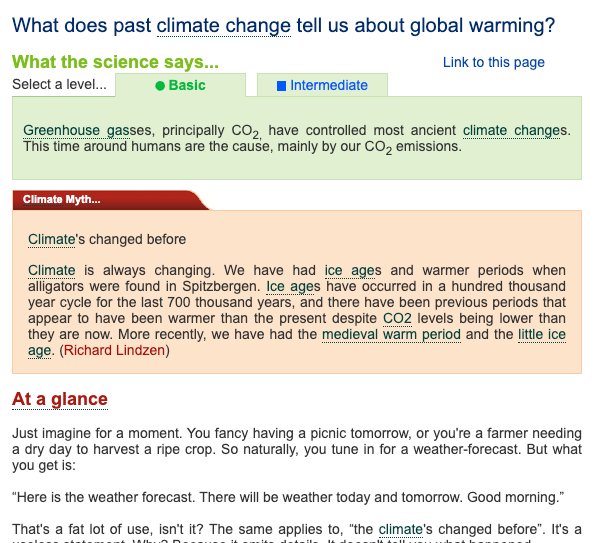
Your first stop to go on a deep dive about the science behind climate change is Skeptical Science. The website has grown over the years and now includes an informative blog that covers current climate events and issues. But my favorite part is the list of climate arguments. If you go to the “arguments” tab, you can sort them by either taxonomy or popularity. For each argument there is a page that breaks down the science, helps you understand the source of the argument, and gives you reliable information about what is really going on. Explanations are offered in basic, intermediate, and advanced options. If you have a question about climate change, the answer is probably on Skeptical Science. And you can trust what they say.
Popular Reading and News
Inside Climate News features detailed analysis and in-depth reporting on current climate events, like this great article about the water crisis in Corpus Christi. They have a useful free newsletter, so you can stay up to date on climate news.
Similarly, I often visit Yale Climate Connections to read more about a current climate event. If there is an unusually strong hurricane or a wildfire, Yale Climate Connections is sure to have an article about it.
For general meteorology news with frequent climate stories, I like Wunderground’s news feed.
International
For international climate news and analysis, World Resources Institute is the place to go. They have good international current events coverage, a deep archive with lots of useful information about science and policy, an informative free newsletter, and frequent webinars and other learning opportunities. During UN Climate negotiations season, WRI will keep you informed.
Hosted by former UNFCCC Executive Secretary Christiana Figueres. Outrage and Optimism has a COP deep dive series that I found helpful during the COP in Belem last year. I continue to listen because they offer an informed perspective on current events like the conflict in Iran and the implications for climate.
Energy
For Texas energy news, including expert analysis about what’s going on at the Public Utilities Commission and ERCOT, I subscribe to the Texas Energy and Power Newsletter and Energy Capital Podcast.
The Texas Tribune also has great energy and climate reporting.
Technical Reports
The Fifth National Climate Assessment is the product of a collaborative effort among hundreds of experts on many disciplines that touch on climate science. The NCA5 contains up to date climate science and specific climate impacts on a number of different fields, like coasts, agriculture, forests, energy, the built environment and more. This is the first place to go to read about the state of the science on climate change US-specific climate impacts.
The National Climate Assessment is delivered every four years as required by the Global Change Research Act of 1990 and is produced by the US Global Change Research Program. More information about the origins of the report and the validation process are available in the Guide to the Report available on the webpage.
It is important to note that the NCA5 was originally published on the US federal government website globalchange.gov, but was removed last summer by the current presidential administration. Developers from that website have left the federal government and are now collaborating on a new website, climate.us, which hosts the NCA5 report and many other climate data resources formerly available on government websites.
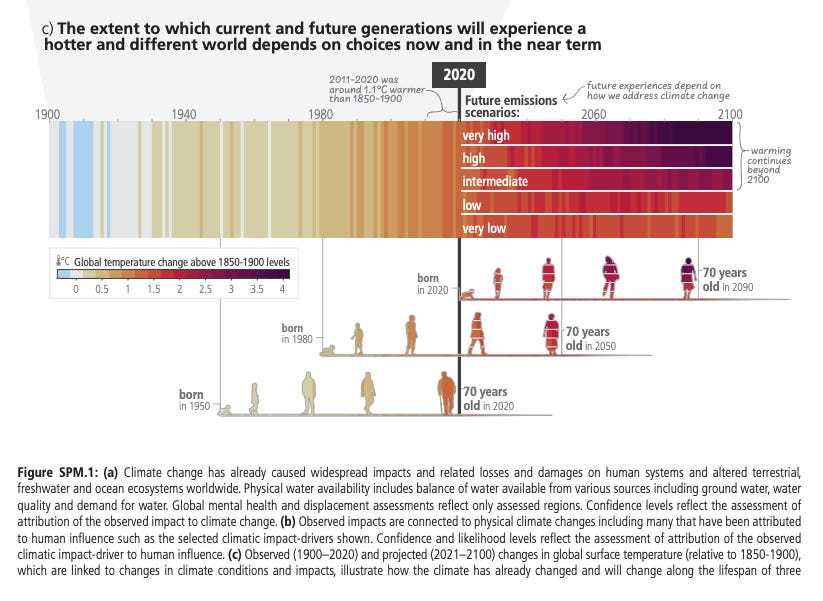
The assessment reports issued every five years by the Intergovernmental Panel on Climate Change (click on “Reports”) are similar to the NCA in that they are written by a large group of experts in climate science and other disciplines like agriculture, health, and atmospheric science. While the NCA covers US climate, IPCC reports are written by an international coalition and cover global issues. IPCC reports represent the state of the science and are updated every few years. Here is a link to the recent Sixth IPCC Assessment Report. I recommend starting with the “Summary for Policymakers,” a helpful summary of the report’s most important findings and graphs.
Thank you. It is hard to find trustworthy information these days.