

The Lynchpin
Understanding the Secretary of State's role in elections


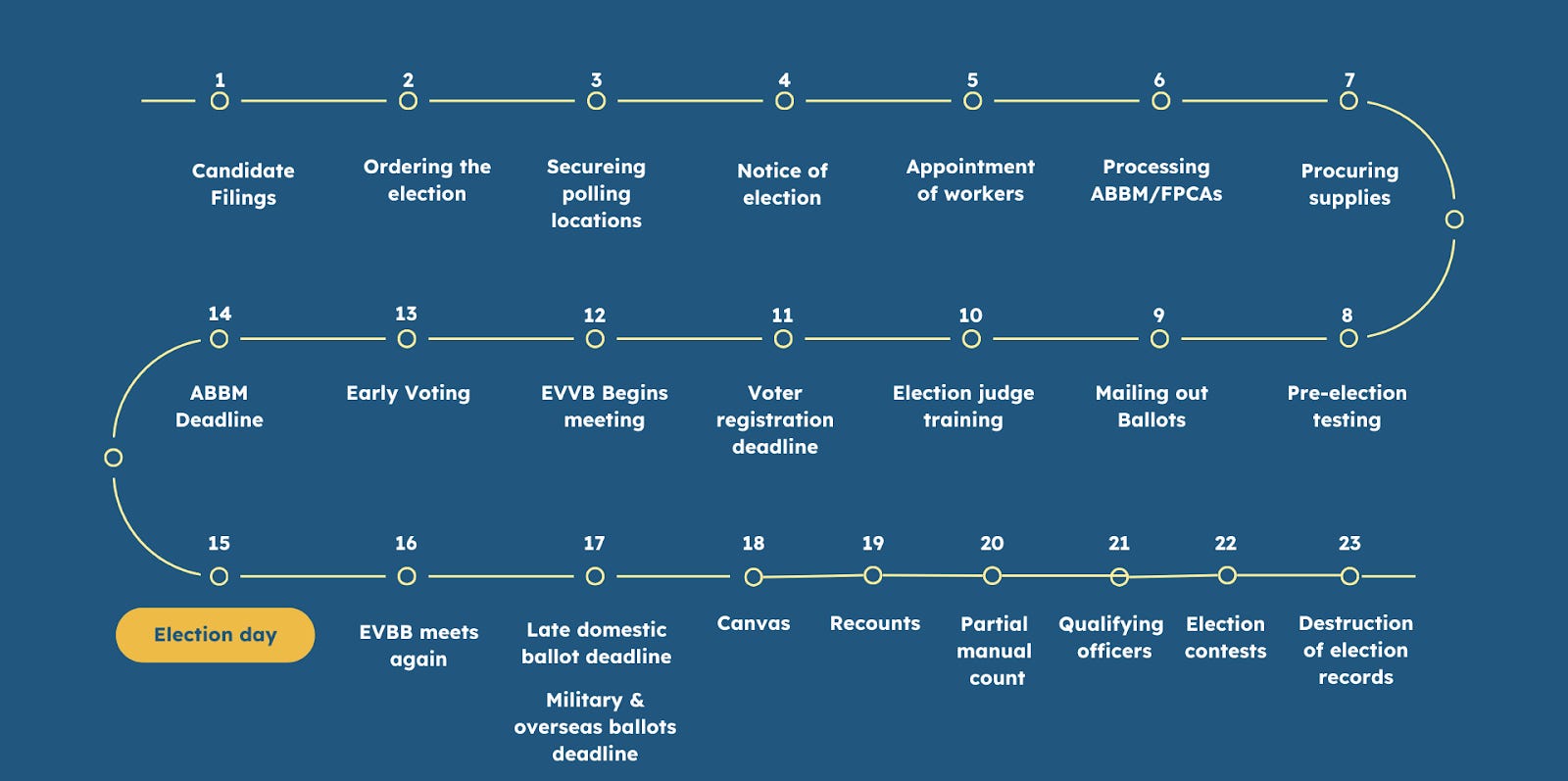
Timeline of a Texas election
What makes our elections happen? How are we able to show up to a polling location, cast our ballot, and know that it’s counted?
This gargantuan task falls to the Secretary of State. Acting as the chief elections officer, their job entails:
Overseeing and administering elections in Texas
Providing guidance to county election officials
Ensuring compliance with state and federal election laws
Maintaining the official list of registered voters (Texas Voter Registration List)
Certifying candidates and ballot measures for statewide elections
Promoting voter education and outreach
Without their work, Texas elections could not run smoothly.
Understanding Texas Elections
Whether it’s a general election, special election, or primary election, it seems like Texans are constantly voting. With the upcoming constitutional amendment election in November—and the primary and midterm elections approaching fast—it’s important to understand the ways our elections happen and how their integrity is ensured.
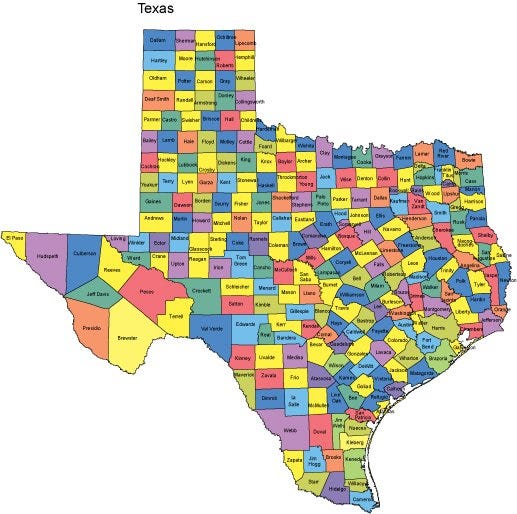
The scale of Texas’ elections is huge.
Texas ranks second highest in voters at 18.6 million and has the most counties at 254—compared to just 67, 62, and 58 in Florida, New York, and California. These counties are further divided into voter precincts, varying from just 1 to 1165 in Texas’ largest county, Harris. Texas’ 38 U.S. Congressional districts, 31 state Senate districts, and 150 state House districts further complicate the Secretary of State’s work.
Precinct size also varies. A precinct contains anywhere between 100 to 5,000 registered voters. Polling locations are recommended by the county election officer and approved by the commissioners court (in primary elections, polling locations for each party are chosen by the political party's county chair). Each polling location must contain at least three workers—an election judge, an alternate judge (judges must be from opposite parties), and an election clerk. The number of volunteers necessary statewide to carry out elections sits in the tens of thousands.
Preparing for Elections
The work of the Secretary of State begins many months before Election Day. Election calendars are posted at the start of each year, and candidates can begin registering around six months before election day. Candidates file with the Secretary of State, who then distributes the list to each county. It is the Secretary of State’s job to make sure that each voter’s ballot contains the correct candidate list according to their precinct.
Although the mechanics of elections are mostly the responsibility of county election officials, the Secretary of State standardizes and oversees the process statewide. For example, the work of educating, registering, and encouraging voters is shared between county officials and the Secretary of State.
Programs like Project V.O.T.E. seek to combat Texas’ below-average voter turnout by educating K-12 students on the electoral process and promoting future voting. The office of the Secretary of State also conducts seminars and elections schools, provides calendars, ballot certification, primary election funding, and legal interpretations of election laws to election officials. On top of that, the Secretary of State creates laws and procedures to ensure poll workers follow election laws. These include publishing the Election Inspector Handbook, Election Judges and Clerks Handbook, Early Voting Ballot Board Handbook, and many more.
Despite the scale of the Secretary of State’s work, their staff and budget are relatively small. The department has only 235 employees and a budget of $5 million for voter education. That’s less than $0.27 per voter. Much of the department's funding comes from the Help America Vote Act (HAVA). In 2020, Texas received over $26 million in HAVA funds and directed the majority of funds to election systems and security instead of voter education and promotion.
As early as three months before election day, the Secretary of State begins to process applications for ballots by mail and will begin to process voter registration at increasing volume.
In order to be able to vote, you must be registered. To do so, voters begin by filling out an application and submitting it to the local voter registrar at least 30 days before election day. Unlike some other states—including Oklahoma and Florida—Texas does not allow for online voter registration.
After the application is submitted by mail and approved, the information is uploaded into Texas’ Statewide Voter Registration Database, known as TEAMS (Texas Election Administration Management system). It is the Secretary of State’s job to maintain and manage this single system. The Secretary of State works with each county voter registrar to ensure the list remains updated and accurate by regularly checking the list and comparing it with other information received from other government agencies.
Additionally, to ensure that registered voters are not removed incorrectly, the Secretary of State creates a process with listed criteria to determine whether to remove someone from the database. Voters are evaluated on whether there is a “strong match” or “weak match” to each criterion. As a result, a voter may be automatically removed, or the local voter registrar will investigate the voter’s eligibility. The criteria is as follows:
Cancellation due to residing outside of county of original application
Cancellation of Deceased Voter Registration
Cancellation due to Mental Incapacity
Cancellation due to Felony Conviction
Cancellation due to Citizenship
Voters can challenge their registration cancellation in hearings and submit further appeals if they are not satisfied with the hearing result. Through these processes, the Secretary of State further ensures fair elections.
Election preparation also requires verification of voting technology and staff. The Secretary of State evaluates vendors and voting systems through an intense verification process that follows federal and state-specific guidelines. There are only two certified vendors in Texas: Hart InterCivic and Election Systems & Software.
Most of the work is done by volunteers who are appointed by county clerks and voter registrars, who follow training guidelines issued by the Secretary of State. For example, volunteers register voters who are then entered into the Secretary of State’s Voter Registration List. On Election Day, volunteer election judges and clerks preside over precincts to ensure that their precincts follow election guidelines. The Secretary of State also works hand-in-hand with county officials to encourage volunteering, especially on Poll Worker Recruitment Day (August 1st).
Voter Access
Notwithstanding Texas’ recent moves restricting access to voting, in the past the legislature has sometimes been at the forefront of increasing voter access. For example, Texas was one of the first states to offer early voting. In the 1980s, counties became authorized to create early voting polling places at locations other than the clerk’s office, and the terminology for this changed from “absentee voting” to “early voting,” now that any voter could cast a ballot early by personal appearance. Known as “retail voting” at the time, many polling stations were located in shopping malls and grocery stores for convenience.
The Secretary of State ensures early voting remains available either through in-person or mail-in ballots. In the 2025 legislative session, Texas legislators passed SB 2753 to extend early voting so it no longer ends on the Friday before election day in general elections.
In order to submit a mail-in ballot for early voting or not, a registered Texas voter must submit a valid excuse/accommodation, unlike in states like Utah, Iowa, and Georgia, along with 25 others that do not. These include:
Being 65 or older
Being sick or disabled
Being out of the county on election day and during the period for early voting by personal appearance
Being expected to give birth within three weeks before or after Election Day
Being confined in jail, but otherwise eligible
Furthermore, for voters not eligible for mail-in voting, additional accessibility options are available at polling locations. The Secretary of State ensures that at each early-voting polling place and election day location, there is at least one voting system accessible for disabled voters. Texas was also the first state to establish accessibility requirements for disabled voters.
Administering Elections
By the time voting begins, the Secretary of State has certified each polling location and provided training for poll workers. Voting systems have been tested and approved.
On Election Day, the Election Judges and Clerks take hold of the reins and the Secretary of State stands ready to support voters. TEAMS provides technical support. The Secretary of State’s office remains available both in person in Austin, TX, and through phone number and email to answer general inquiries.
Finalizing Election Results
As voters go home, the next step begins—canvassing the votes. Canvassing involves compiling data across multiple locations and certifying it. Vote canvassing begins at the county level within the commissioners court, typically within a week after election day. Statewide canvassing is then done by the Secretary of State and is facilitated by the data reported from across all counties.
Any recounts must meet minimum requirements (such as a maximum difference of 10% in votes between the top two candidates). They must be filed within three business days after the canvass and be overseen by the Secretary of State.
After canvassing is finished, the Secretary of State publishes the official results on their website, and elections are finalized. Randomized statewide audits are conducted afterward to double-check election processes.
In sum, the Secretary of State plays an essential role in preserving and strengthening democratic processes. While much of the work of elections is carried out locally, the Secretary of State connects the jigsaw pieces into a coherent finished puzzle.
 | A guest post by
|
 | A guest post by
|