


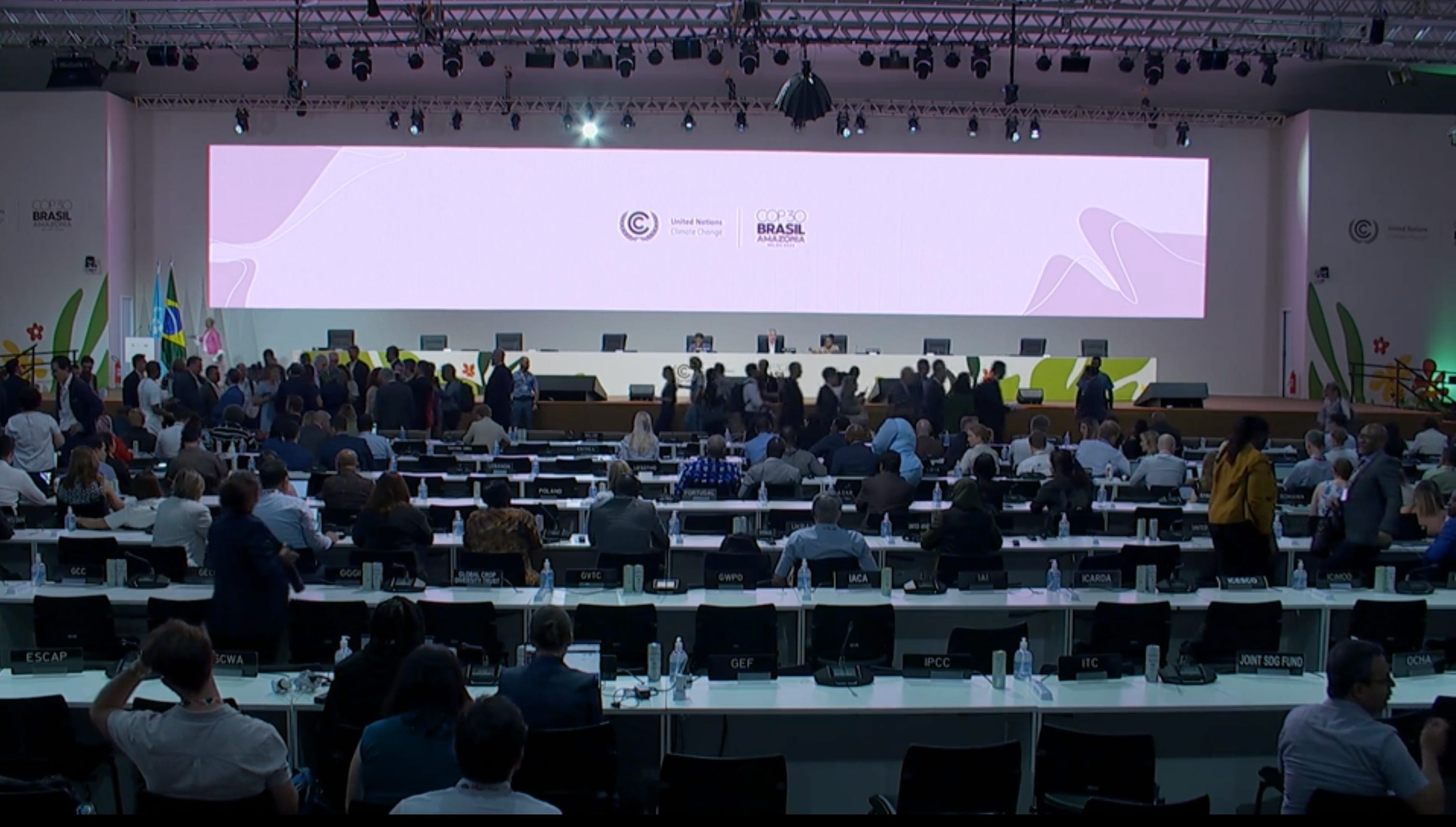
The second week of COP30 is the “high level” portion of the event. Last week, negotiators and civil society leaders were holding “informal consultations” and “facilitative sharing of views,” but starting with the High Level Opening Plenary, the heads of state are here and the mood has shifted.
At the Opening Plenary, representatives of each nation deliver a national statement. The statements can include everything from self-congratulatory recitations of recent climate achievements, to exhortations to other national leaders, to airing of grievances about the UNFCCC process. This year’s plenary—which will extend through Tuesday—has featured yelling, tears, and accusations of bad faith as well as descriptions of heroic actions by small island nations.
Speaking on behalf of the Association of Small Island States (AOSIS), His Excellency Mr. Steven Victor, the minister of agriculture, fisheries, and environment of Palau, said for countries like his, “1.5 is a survival limit, not a slogan.” AOSIS has put forward a proposal to create more accountability for national pledges to reduce carbon emissions.
Some other parties say such a plan amounts to finger-pointing and assigning blame, but another AOSIS member, Tuvalu, insists the proposed “NDC Response Plan” is not about pointing fingers but about collective action to address a crisis.
The crisis is that as each nation puts forward its “nationally-determined contribution” of carbon emissions reductions—its NDC—that national contribution goes into a global pool. The global total collectively is supposed to reduce carbon enough to keep global temperatures from rising more than 1.5C. Unfortunately, according to analysis by the World Resources Institute, the NDCs submitted so far in the 2025 submissions achieve less than 14% of the additional emissions reductions needed by 2035 to close the gap to 1.5 degrees C.
Small, vulnerable nations have few emissions to begin with, so they depend on large emitters like the US to commit to more “ambitious” NDCs. So far, as one COP participant explained it, the situation is like a big dinner at a restaurant, where the check goes around and everyone puts in what they think they owe—except when everyone has paid, there’s still money left unpaid.
The Marshall Islands are one of the first island nations to face the possibility of complete loss of their land due to sea level rise. Minister of the Environment Mr. Bremity Lakjohn described his culture’s practice of burying the umbilical cord of each new baby on its family’s land—a promise that no matter where that child goes, it is always connected to its family, community, and country. What happens to that promise, Lakjohn asked, if the entire country is covered with the rising ocean?
Other national statements focused on their own ambitious activities. El Salvador’s environmental minister, Mr. Fernando Andrés López Larreynaga, characterized his nation as, “the country of surfing, coffee, and bitcoin.” He painted a picture of a community that has taken on climate change as a national challenge, describing reforestation, K-12 climate education, and other initiatives showing that, “what seemed impossible can be achieved.”
The national statements continue for a second day…so stay tuned.
Watch Part 1 and Part 2 of the plenary from Monday, November 17, 2025