

“We Can Only Be Human Together”
planks, platforms, principles, priorities, polities

This week, Texans have been perusing the Republican Party of Texas’ draft 2026 legislative platform, which the party adopted at its recent statewide convention in Houston. Next week, the Texas Democratic Party will hold its statewide convention in Corpus Christi, where it will adopt its 2026 platform. The Libertarian Party of Texas held its 2026 convention in Abilene in April, and the Green Party of Texas also is holding its 2026 convention next week—and both of these parties will consider their own platforms.
A platform is intended to encapsulate a party’s policy priorities, and to communicate to its members, policymakers, and the public what is distinctive and important about that party’s policy orientation. In an election year, platforms are expected to help voters choose the party affiliation that best aligns with their own values. Legislatively, platforms are expected to serve as a kind of North star for lawmakers, helping them stay focused on the principles they were elected to uphold.
Each of the following statements comes from the preamble to the platform of one of the parties mentioned above. While you may be able to identify which platform each quote comes from, you can also see that they all point to widely shared, deeply held American ideals.*
Throughout the world, people dare to dream of freedom and opportunity. We unequivocally defend that dream.
We seek a world of liberty; a world in which all individuals are sovereign over their lives and no individuals are forced to sacrifice their values for the benefit of others.
We believe government exists to achieve together what we cannot achieve as individuals; and government must serve all people.
Understanding that our actions will be judged by future generations, we work together in order to build a safer world for everyone.
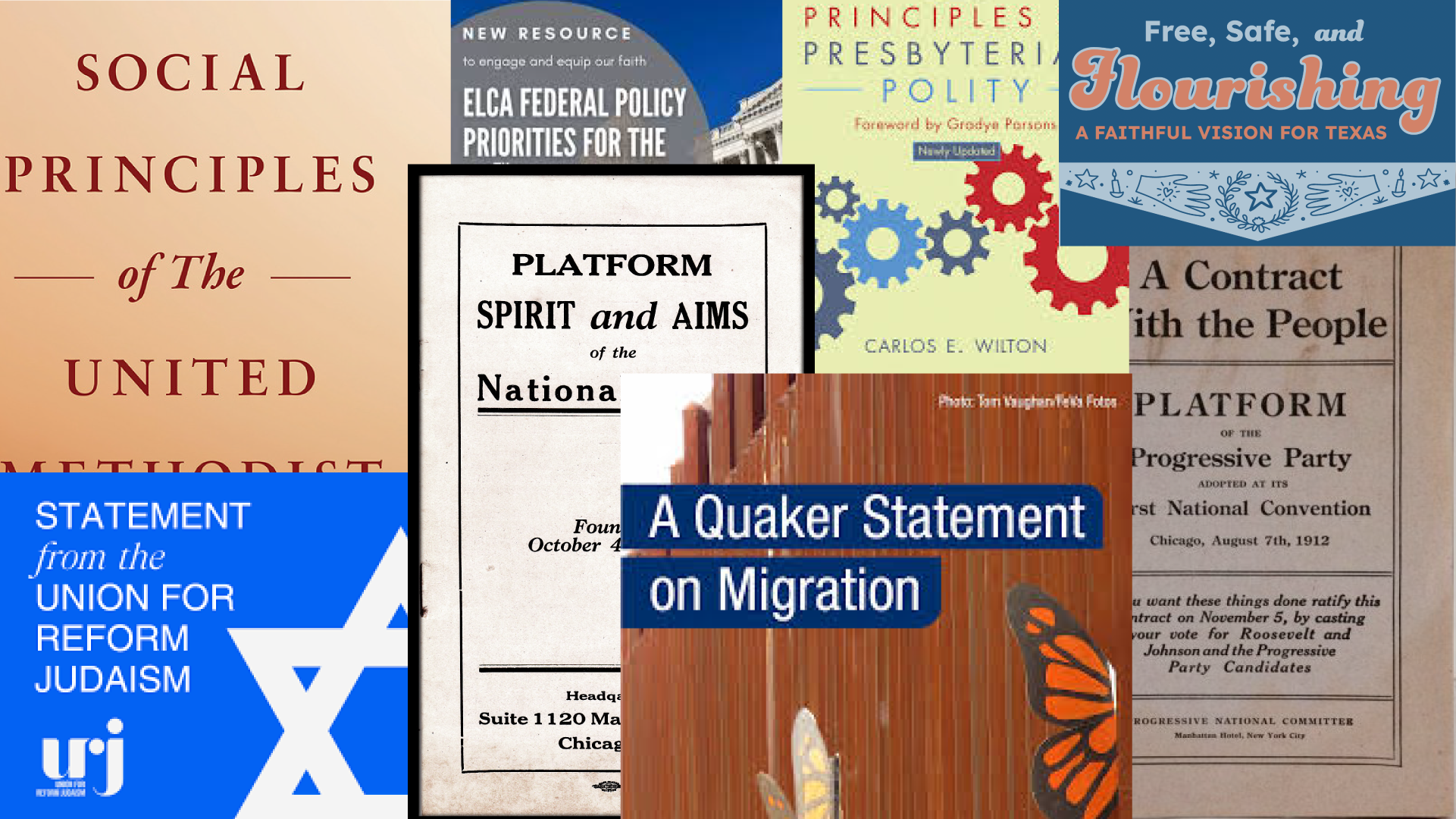
Political parties are not the only authors of policy platforms. Denominations and faith traditions also adopt “platforms,” and like for political parties, those documents can be subject to periodic revision. Denominational statements of principles usually are referred to as “social statements.” They typically are drafted by committees of theologians, ethicists, and others in the denomination who have deep knowledge of the denomination’s beliefs, creeds, and historic positions.
Denominational positions usually are adopted or moved along in the adoption process at the denomination’s national convening. Schedules for these meetings vary, with some biennial, some triennial, and some quadrennial. Next week, the Presbyterian Church (USA) is considering a number of policy statements at its General Assembly, including a proposed statement On Taking Action to Repudiate Christian Nationalism and Affirm Our Faith Commitments that draws on the work of Texas Impact’s partners at the Baptist Joint Committee for Religious Liberty (BJC).
In 2028, the United Methodist Church, the Evangelical Lutheran Church in America, the Presbyterian Church (USA), and the Union of Reformed Judaism are among the denominations that will hold national convenings where they could consider adopting new platforms or statements. The Episcopal Church will hold its next national convening in 2027.
Advocacy organizations, including Texas Impact, typically adopt “platforms” and lists of policy priorities to guide their work in the legislative and executive processes. Texas Impact’s Leadership Council adopts its biennial policy agenda in September of even-numbered years. See Texas Impact’s 2025-2026 policy agenda
Texas Impact’s Leadership Council will adopt its 2027-2028 policy agenda at its biennial legislative retreat August 30-September 1. During the next several weeks, our action teams and Leadership Council members will be studying the issues and consulting with colleagues, partners, and legislators to identify the issues we should focus on in the upcoming legislative session, in light of our mission and vision for Texas.
Texas Impact’s policy agenda features a unique constraint: Our positions cannot contradict the national positions of our Supporting Organizations, which include Christian, Jewish, Muslim, and interfaith bodies. The Leadership Council members must be well-versed in the policy positions of their own faith traditions, so they can flag issues where there is significant divergence among their national statements. In practice, this sometimes means Texas Impact does not take a position on an issue of interest to many of its members: Notably, Texas Impact did not have a position on abortion until national denominations made statements following the Dobbs decision.
Sometimes, bodies adopt policy positions outside of their normal schedules. For example, Texas Impact’s Leadership Council recently adopted a statement opposing closed primary elections. The statement says in part, “Taxpayer-funded elections, including primary elections, should allow all registered voters to participate without pledging their allegiance to or membership in a political party. Barriers to participation interfere with personal religious expression, not just civic activity.” In adopting this statement, Leadership Council members pointed out that an individual’s faith and values are their primary guide in voting as in all of life; political party affiliation—or the platform of a political party—should never be permitted to constrain the individual right of conscience.
Over the next several weeks, I’ll be doing a deep dive into denominational statements—where they come from, what they say, and how they relate to Texas Impact’s policy agenda. In the process, I’ll explain some details about ecclesiastical polity and provide some behind-the-scenes information about how denominational bodies in Texas do their policy work. There will be a lot of terminology, starting with the term denomination, which does not apply only to Christian churches. There also are denominations within the Jewish, Muslim, and other faith traditions.
If you’re wondering what the Texas political party platforms say beyond their preambles, here they are:
Republican Party of Texas (and the just-adopted legislative priorities for 2027)
Texas Democratic Party platform
Libertarian Party of Texas platform
As you read the platforms—and as Texans and Americans consider, debate, and sometimes obsess over which set of partisan principles best aligns with their personal beliefs—it would be good to remember that we have much more in common than we sometimes acknowledge.
“My humanity is bound up in yours, for we can only be human together.” — Desmond Tutu
Love,

* (Can’t guess which quote goes with which party? Come back for next week’s installment of Notes from the Hive!)