

"We Have No Regrets"
Storytelling as Advocacy

In the last week of June, more than 100 abortion advocates from across the country gathered in Washington, D.C., at the Our Voices, Our Stories, Our Future: Free & Just Storyteller Summit, which was timed to coincide with the third anniversary of the Supreme Court’s Dobbs decision that overturned Roe v. Wade. Participants included seasoned abortion rights advocates such as Amanda Zurawski, Samantha Casiano, and several other plaintiffs in the Zurawski v. Texas case, as well as women and families who were sharing their stories publicly for the first time.
The convening brought together women who have suffered harm to their own health care and lives abortion bans family members of women who died as a result of delayed or denied care; abortion clinicians; medical students; OB-GYNs and maternal fetal medicine specialists; faith leaders; and veteran advocates who have worked for abortion access since the 1960s. The characterization “storyteller” drew a circle large enough to include not only those who had undergone, sought, or needed an abortion, but all whose lives have been touched by abortion issues. Abortion bans impact everyone, not just those in need of care. The diversity of perspectives at the convening made this reality manifest, as every person there had something to add to the discussion of expanding access nationwide.
Amanda Zurawski, a well-known advocate and storyteller, brought the skills she’s gained as the lead plaintiff in a major lawsuit to a workshop for fellow attendees. As a prominent figure in Texas and nationally who speaks about the dangerous and deadly effects abortion bans have on women, she spent her time at the convening coaching other women on effective storytelling.
Texans made up the largest state contingent at the event. This makes sense, as we have the largest population of any state with an abortion ban.
However, it turns out Texas plays an outsized role in the national abortion conversation not only because of the impact our state’s ban has on Texans, but because of the negative ripples Texas’ restrictive policies are causing in states where abortion access is protected. People from states where abortion is still legal, like New York, shared stories of the increased demand from Texans in those states’ clinics and demand for telehealth and mail-order medications straining their resources.
While many of the storytellers at the convening had significant experience engaging legislators, media, and community members, the conference leaders were diligent in elevating the stories of individuals who only recently had joined the ranks of the directly impacted. Regardless of the differences in their specific experiences, participants all came to the convening with a shared conviction that abortion restrictions are harming Americans and demands immediate remediation from elected officials.
In the first panel of the convening, researchers who focus on the psychology of abortion messaging reminded the storytellers that what we say and how we say it matters. Adrienne Kimmell of Spark Solutions and Joey Teitelbaum of Global Strategy Group, worked on several abortion ballet measures in the last election cycle. They emphasized the need to avoid terms that reinforce existing stereotypes, for example by opting for “anti-abortion” instead of “pro-life” to disrupt the idea that abortion bans are saving lives. Changing our language can improve communication both with abortion advocates and with individuals who might be turned off by common abortion buzz words.
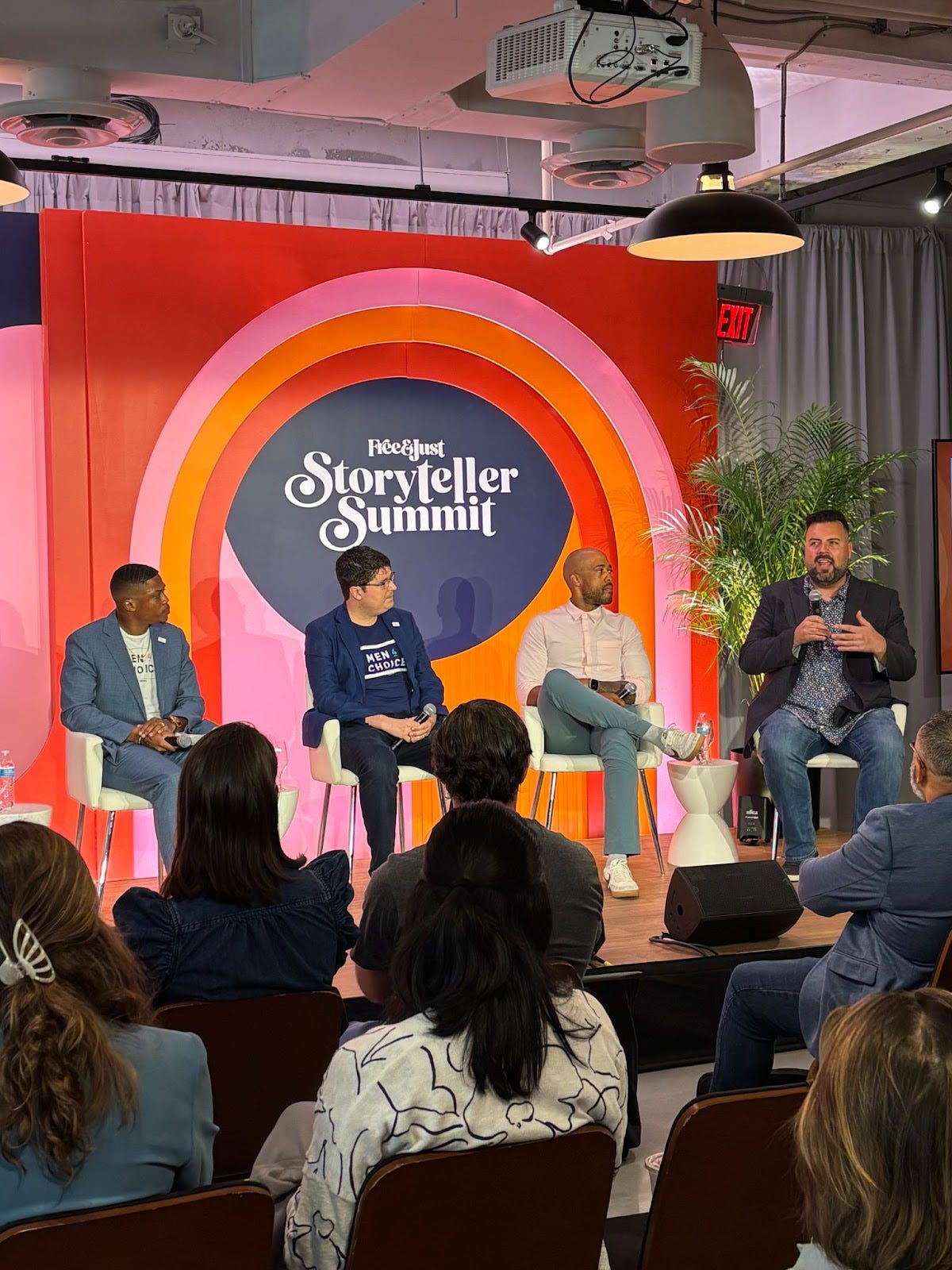
Aaron Bos-Lun of Men4Choice, former Wisconsin Lt. Gov. Mandela Barnes, academic and content creator Professor Chesko, and Davan’te Jennings of Men4Choice discussed men’s involvement in the movement for reproductive rights. Each panelist shared their experiences being supportive of reproductive rights but being unsure how to join women in advocacy work.
Bos-Lun cited statistics from Pew Research Center that 61% of men are supportive of reproductive rights and abortion access, lamenting that despite this support, 59% of men voted for Donald Trump in the 2024 presidential election. Former Lt. Gov. Barnes spoke about finding out during his campaign as an outspoken advocate that abortion was part of his own story, learning that his mother had a complicated first pregnancy, and had an abortion. While he was and remains an advocate for access, learning this made his understanding of the issue much more personal. Professor Chesko, a prominent content creator, theater and communications professor, talked about his approach to reaching young men, who are far more likely to be radicalized by online far right content than any other group. Chesko stressed his motivation to reach young men with messages about abortion and the freedom to make personal decisions—messages and an audience that have been missing in the landscape of the abortion policy debate.
Each of the panelists emphasized the importance of reaching other men and giving them somewhere to go to take positive actions for reproductive rights and abortion access. Despite obvious hesitations from many about involving men, including men who are new to reproductive policy issues, it was clear that without taking intentional steps to activate them, these supportive men are likely to be targeted and sometimes mobilized by anti-abortion groups instead.
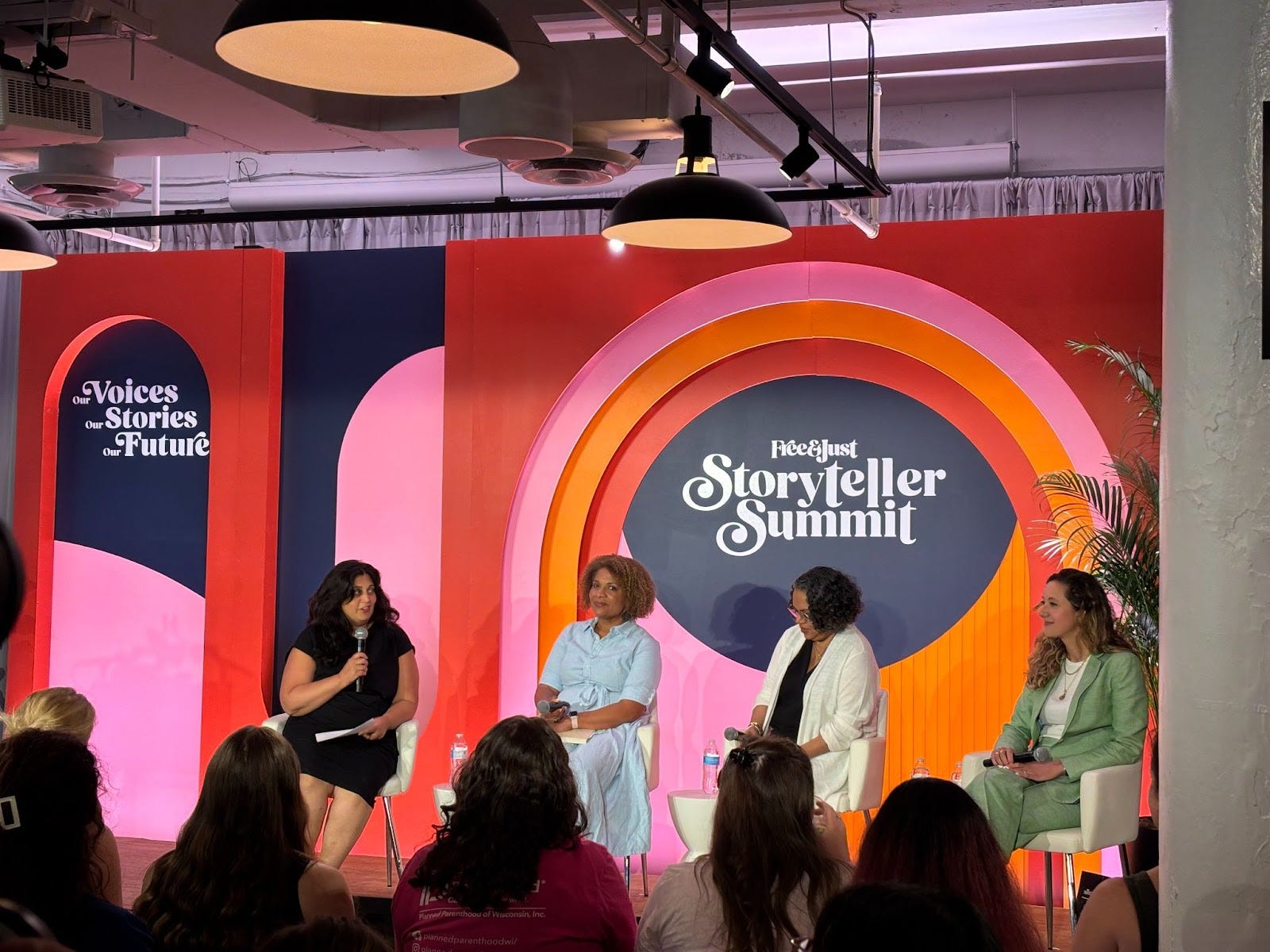
The convening closed with a riveting conversation between Shilpa Phadke, former White House Gender Policy Council; Fatima Gross Graves, Executive Director of the National Women’s Law Center; Mini Timmaraju, President of Reproductive Freedom for All; and Yasmin Radjy, Executive Director of Swing Left and Vote Forward. Representing decades of experience, the panel reflected on the biggest battles they anticipate lie ahead for reproductive rights on a national level. Among their biggest concerns were the enforcement of the Comstock Act; attacks on Medicaid that impacts access to reproductive health care of all kinds; challenges to FDA approval of the abortion medication mifepristone; and attacks on laws that require the provision of lifesaving emergency care including abortion.
One major policy challenge the conveners identified concerns support for religious denials of care around abortion and reproductive health care. Texas has been on the vanguard of these denials—while SB 619 and SB 2880 failed to pass in the recently ended Texas legislative session, these bills and others like them represent real threats to religious freedom. Texas Impact is committed to equipping and mobilizing Texans of faith and conscience to speak with state legislators about the impacts bills like this would have on all Texans’ freedom to live out their deeply held beliefs.
On the last day of the convening, storytellers moved from the conference center to Capitol Hill to share their stories with their U.S. senators and representatives. A coalition of storytellers from Texas met with offices for congressional districts from various parts of the state, including Tyler, Huntsville, Frisco, and Houston. Notably, none of the storytellers from Texas were able to meet with anyone from Senator Ted Cruz’s office as they did not respond to the requests for a meeting.
At each meeting, the women affected by the abortion bans shared their stories with the congressional staff. The Texas cohort included individuals with deep knowledge about speaking with legislative staff members, as well as individuals who had only recently shared their stories with close family and friends.
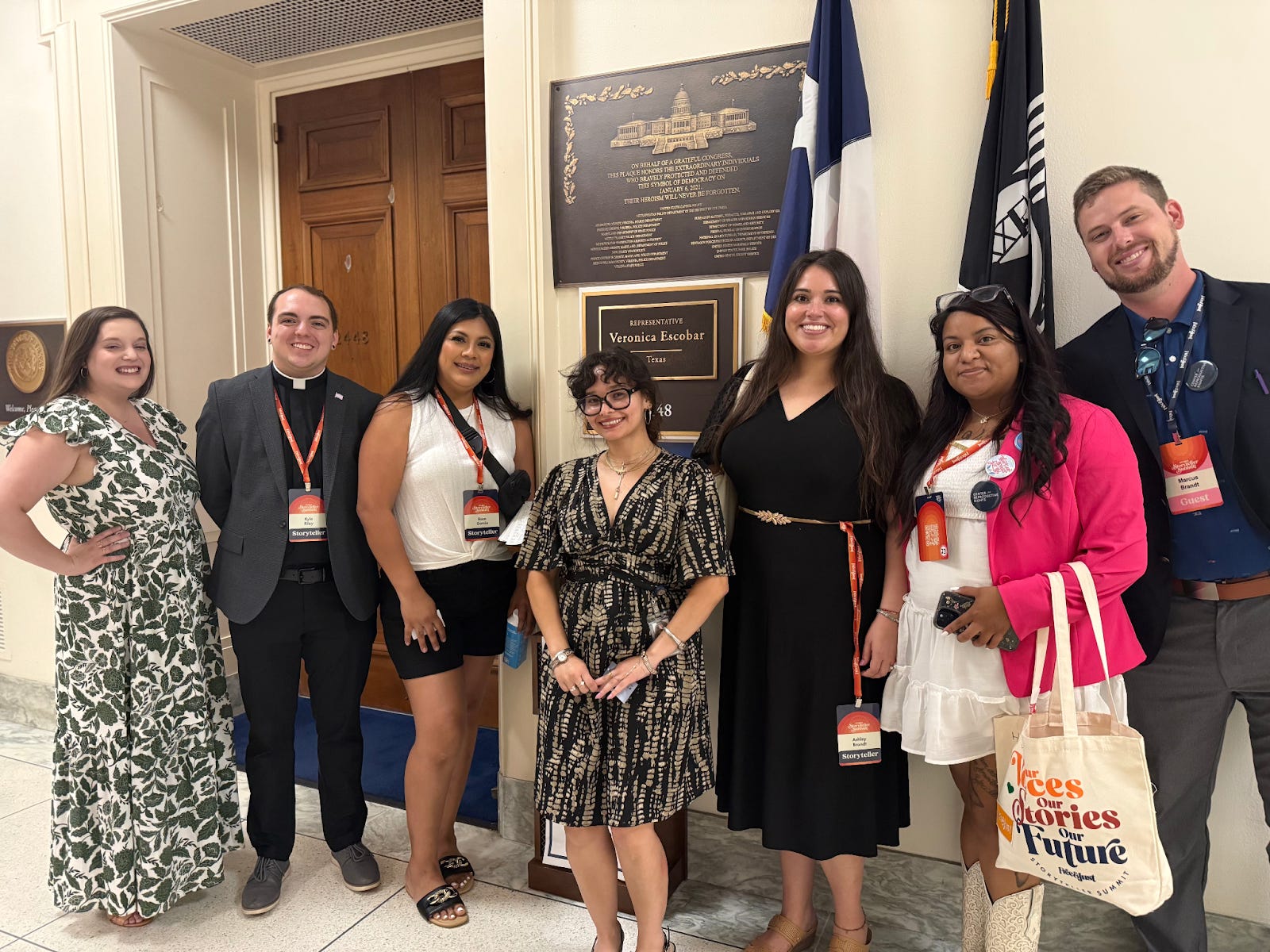
One of the women, Ashley, who was accompanied by her husband, shared her story of finding out that one of the twins she was carrying had anencephaly—a severe birth defect where the embryo develops without parts of the brain and skull. Texas doctors confirmed that the diagnosis was fatal for that twin, and without an abortion, the other twin and Ashley could be at serious risk of infection and death. However, because of Texas’ abortion ban, Texas doctors could not legally perform a fetal reduction, where the nonviable fetus would be aborted without harming their healthy twin. Ashley and her husband were forced to seek care in another state.
Already parents to a young boy, they could not justify allowing this pregnancy to result in his growing up without a mother. The harm the nonviable fetus posed to the healthy twin was the last piece in the puzzle of their difficult and deeply personal decision to seek a fetal reduction abortion. “We have no regrets about our decision,” the couple shared with congressional staff. “Our sick daughter needed our mercy, and we gave that to her. Because of the care we got, our pregnancy with our healthy twin went on completely normally. Our daughter is a wonderful young sister to our son today. Ashley is still here to mother them both. That would not have happened if we hadn’t gotten an abortion.”
Anencephaly is a kind of fatal fetal anomaly—a congenital abnormality that is highly likely to cause death either before birth or shortly after birth. Abortions are not legal in Texas in cases of fatal fetal anomalies since the abortion ban took effect. Samantha Casiano, a plaintiff in the Zurawski lawsuit who is featured in the documentary film about the case, also experienced a pregnancy with a diagnosis of anencephaly. Unlike Ashley, however, Samantha’s circumstances did not allow her to leave the state after receiving her diagnosis early in her pregnancy. Between lack of childcare, lack of paid time off, being a single car family, and not having funds to fly, Samanatha had no choice but to carry her pregnancy to term. In each office, Samantha recounted her story and the traumatic end her daughter had to suffer in her four hours of life, in one office sharing a photo of Halo. Samantha said she shares Halo’s story and photo with the world because “it did not have to be that way.” She points out, “If Halo had been in an accident and no longer had a brain, we could have been given the option to take her off of life support and give her mercy.”
These women were all harmed by the Texas abortion ban, passed by the Texas Legislature. It’s understandable that several of the offices we met with were quick to note this was a state issue, not a federal one. However, the people they are elected to represent are suffering from the state's laws, and they are particularly poised to address these harms by advocating for federal protections for reproductive rights. It’s important that advocates do not let federal lawmakers forget their responsibilities and accountability to the people in their home districts, including how they are affected by state policies.
It’s also important to remind congressional representatives that extreme abortion bans hurt everyone in the state who is or might become a health care consumer: recent research shows a significant impact on the Texas medical system, particularly a decrease in medical school students applying for residencies. The decrease is especially evident in pediatrics, emergency care, and obstetrics and gynecology.
Abortion often carries stigma: it engenders guilt and shame for having sought that care, no matter for what reason. Abortion stories carry stigma, too: social cues suggest that people who access abortion care should never share their experience out loud.
The very existence of the storytellers’ convening challenged that idea. Many attendees said they were surprised and relieved at the level of comfort they felt sharing their stories with one another, and the confidence they gained to share their stories in their lobby visits.
Policy changes are significantly easier when cultural changes push them. The cultural shift starts with telling the stories—what happened to you, to someone you love, or a story of someone you’ve never met but can’t stop thinking about after you’ve learned it.
Stories are foundational to the faith community. They drive our understanding of our beliefs and impact the way we view the role of faith in our everyday lives. Fundamentally, our faith traditions teach us not simply to go in the direction the world is pointing us. Instead, we are to lead with our words and actions as an example of what we want the world to look like.
Kyle, very informative for readers interested in helping in the battle for reproductive rights for women and families!