

Wish Upon a STAAR?
"an accountability response—not a teaching plan"


We left our last article with a deeper understanding of the chronology of standardized (mandated) testing in Texas. From No Pass No Play to End of Course exams, we covered our bases. This next installment in a 4-part series focuses on understanding what is included on STAAR, how test results are utilized, the true nature and intent of progress monitoring, and of course, a big finale on HB 8.
First, I’d like to ask you to consider what I believe to be truths about PK-12th grade education:
Families and communities need schools to provide timely, accurate information about how their students are progressing academically.
Non-disabled students should be able to make at least an academic year’s worth of growth each academic year.
Disabled students should be able to make a ‘reasonable’ amount of growth as determined by caregivers, disability specialists, and schools.
Academic growth can be accurately measured without high-stakes tests.
Assessment data (formal or informal) should be used to inform future instruction in the classroom and not make long-lasting decisions about an entire school system.
What STAAR Looks and Feels Like
The State of Texas Assessments of Academic Readiness (STAAR) is designed to align with the Texas Essential Knowledge and Skills (aka - the TEKS). The TEKS, you’ll recall, are the “knowledge and skills” each Texan student should obtain during the course of a school year. The TEKS are divided into foundation and enrichment (things like PE, music, health, etc.).
The STAAR tests the foundation TEKS in math, language arts and reading, science, and social studies. Grades 3-8 take the regular STAAR test. STAAR End of Course (EOC) exams are the Texas standardized tests for high schoolers. Their tests include Algebra, English, Biology, and U.S. History.
Here are some EOC examples from the 2025 exam in Algebra I:
What are the solutions to the equation: (2x+1)2=25(2x+1)2=25(2x+1)2=25?
Graph the solution set for the inequality: y>5x−3y>5x-3y>5x−3
(I don’t know about you, but I prefer my letters in the form of words.) Moving on.
One positive change that has happened to standardized testing in Texas over the years is how much testing accommodations for students with special needs have grown. Think about it. If you have dyslexia, you probably need extra time for your tests. Sitting in a room with everyone plowing through the test while you are trying to read is not only distracting, but demoralizing. Today, a student with dyslexia might be able to use text to speech, large print, or oral administration to ensure equitable access to the STAAR.
Students have the entire school day to take their test; however, the State suggests scheduling for approximately 3-4 hours since the anticipated time to complete one test is three hours. Most testing now occurs online, so campuses must ensure devices and platforms are ready.
The Time STAAR Broke
Texas outsources testing to assessment companies to not only develop, but provide digital platforms for students to take STAAR. In 2021, already a rough year in light of COVID, Educational Testing Services (ETS) was the State’s vendor. The April 2021 STAAR administration proved disastrous as many students could not log on to the test and some even got locked out of the test. The TEA ultimately had to cancel testing for that day. Speaking of canceling, ETS was uninvited to be the testing vendor after that.
Now, Cambium Assessments is the testing vendor for Texas, and while they have had a few minor snafus, students have had far fewer issues accessing their tests.
What are the Test Scores Looking Like?
Below is a table outlining how 3rd-8th graders have fared on STAAR since COVID. I do want to highlight that STAAR had a big makeover in 2023 to include different types of questions, including short and extended constructed responses. Please remember this is not straight apples to apples when reviewing this data.
Note: Spring 2020 STAAR was canceled statewide due to COVID-19 disruptions; 2023 reflects the STAAR redesign/reset, so compare 2021–22 separately from 2023–25. Data below are from TEA’s 2025 statewide results tables.
Statewide View of % Meets Grade Level (Passing) for RLA and Math STAAR Grades 3–8
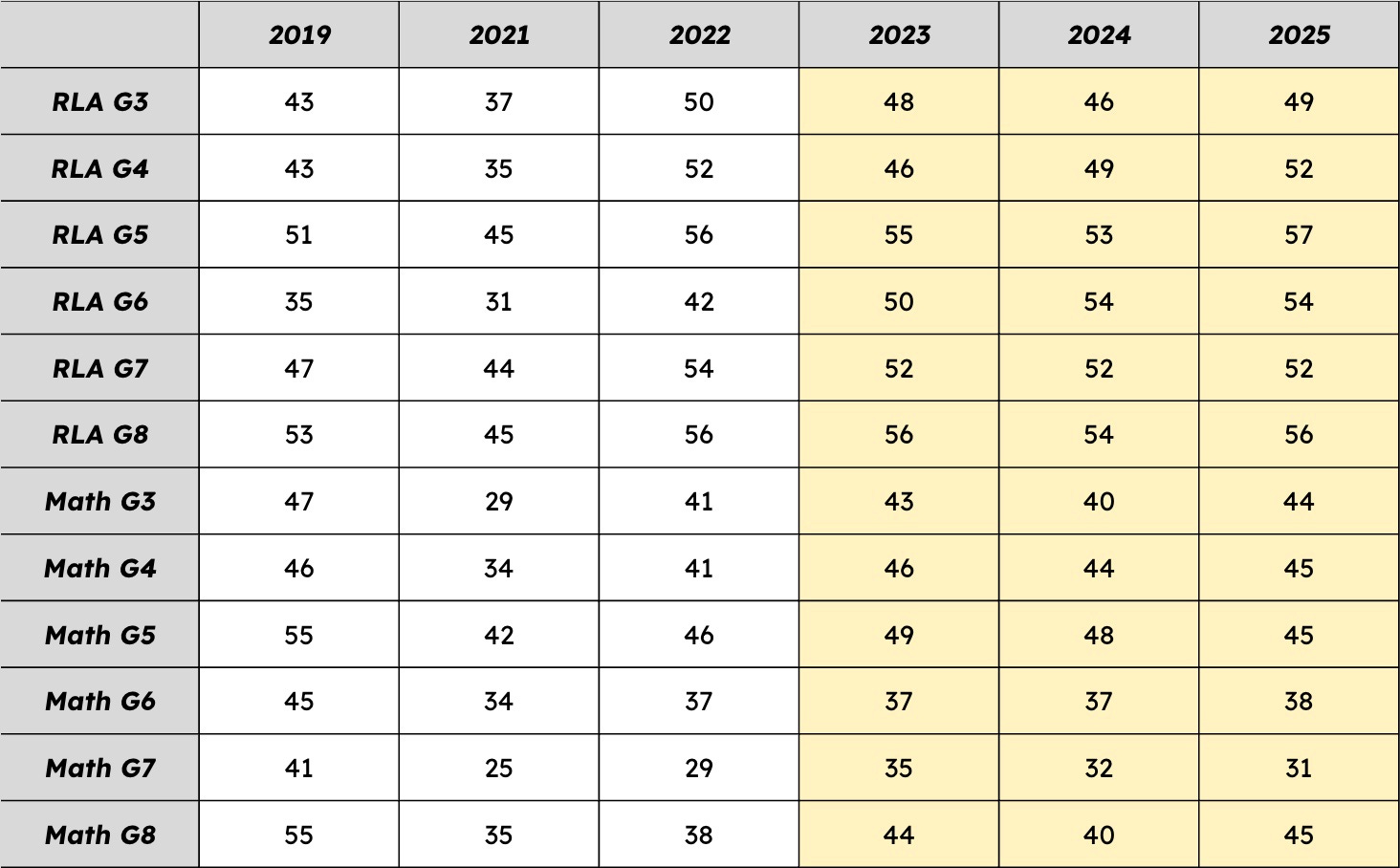
Looking at this chart, one can quickly see that math still lags behind reading in Texas. And something big is going on in 7th grade math. Let’s backtrack a bit. In 2020, the current crop of 6th graders were in kindergarten (2019-2020), so the kids taking the 7th grade tests were in 1st grade when COVID hit. I remember it well because my own 6th grader was in kindergarten until spring break of 2020. Once the pandemic struck, students were set back at least a year and a half. My son did not return to school in person until the very end of 1st grade. We tried our best, but our son has had to catch up on certain skills.
The data in the chart shows last year’s test results, but if you count back at what age most of these kids would have received foundational mathematics knowledge (i.e. kindergarten - 2nd grade), they missed huge chunks of the curriculum. Math has to be taught in a certain order to ensure foundational skills are in place prior to building new knowledge. Without that solid start, it is no wonder our kids are having trouble getting ahead. My theory why we didn’t do as poorly on reading is because parents were much more likely to ask their kids to read a book than do a page of math facts while they were home during the pandemic.
Who’s Looking at the Data?
In a very ideal setting, the test data would be disaggregated by class to ensure high-quality lesson plans and interventions were in place to help all students fill their gaps, so next year’s data will look even better. More often, STAAR data is used to create targeted intervention groups. Per HB 4545 which was updated to HB 1416, schools must provide “accelerated instruction” (i.e. targeted intervention) for any student who scored “approaches grade level” or below. This is the law which makes this a compliance measure.
The data also gets picked up by the media to give an indication of how well our schools are performing and provide specifics on upward or downward trends. Then it finds its way to sites like Niche and Great Schools so potential homebuyers can decide whether or not to live in certain neighborhoods.
So, here’s a question for you. STAAR, or really any state required standardized test, is supposed to measure how well students mastered the TEKS (what Texas said they were intended to learn), and it appears that the data is rarely used to measure actual student progress. It becomes a very black and white process. “You didn’t pass? You go to tutoring. You passed? Go to class.” That’s an accountability response—not a teaching plan.
Progress Monitoring - It’s Good, but Not the Way Texas Proposes
Proposed Texas House Bill 8 eliminates the STAAR and moves to an “instructionally supportive assessment program” (ISAP) which provides beginning, middle, and end of year progress monitoring. As opposed to 15 required STAAR tests between 3rd and 8th grade, the State is now proposing 51 tests (called progress monitoring) between 3rd and 8th grade. Students in grades 3-8 would now take three tests (beginning, middle, and end of year) in assigned content areas. High schoolers still must take End of Course (EOC) exams as in past years. ISAP is intended to be diagnostic in nature and help teachers plan lessons accordingly; however, we do not have information regarding the final tests’ weight on students or schools. The “progress monitoring” is timed.
Progress monitoring is far more organic in nature than a 105 minute test at the end of the year. It is about consistently monitoring individual students’ growth and is not intended to be a high-stakes test. If you’ve heard of the MAP Test (Measure of Academic Progress) then you already know of a progress monitoring tool. MAP is adaptive, so it can dial up the heat when a student is answering correctly and also dial down to help find a comfortable, yet challenging, fit for a student who needs it. Frequently, students use digital tablets to take the MAP, and at least for my son, he thinks it’s kind of fun. The data obtained from the MAP gives individualized reports which help teachers and parents identify gaps in learning. Ideally, in a school year, the progress monitoring would show a grade’s worth of growth from the beginning of the year, to the middle of the year, to the end of the year. Used correctly, progress monitoring is easy to implement, useful to teachers, and not overly stressful for the kids.
A standardized test is merely a snapshot of a moment in time in a student’s life, and in this instance, potentially three or thirteen snapshots depending on the grade. Texans should be highly concerned that the “instructionally supportive assessment program” is simply a way to rebrand the STAAR. (Not unlike when vouchers became “Educational Savings Accounts”.) Although it is being touted as progress monitoring, the proof is in the pudding. We will need to see those tests and understand how school accountability will be measured. Currently, it looks like STAAR with a wig on its head.
In the next installment, we will get in the weeds on HB 8 and talk about potential implications of the legislation for Texas school kids.